
Peptide Pharmacokinetics: How the Body Handles a Peptide (ADME)
Peptide science
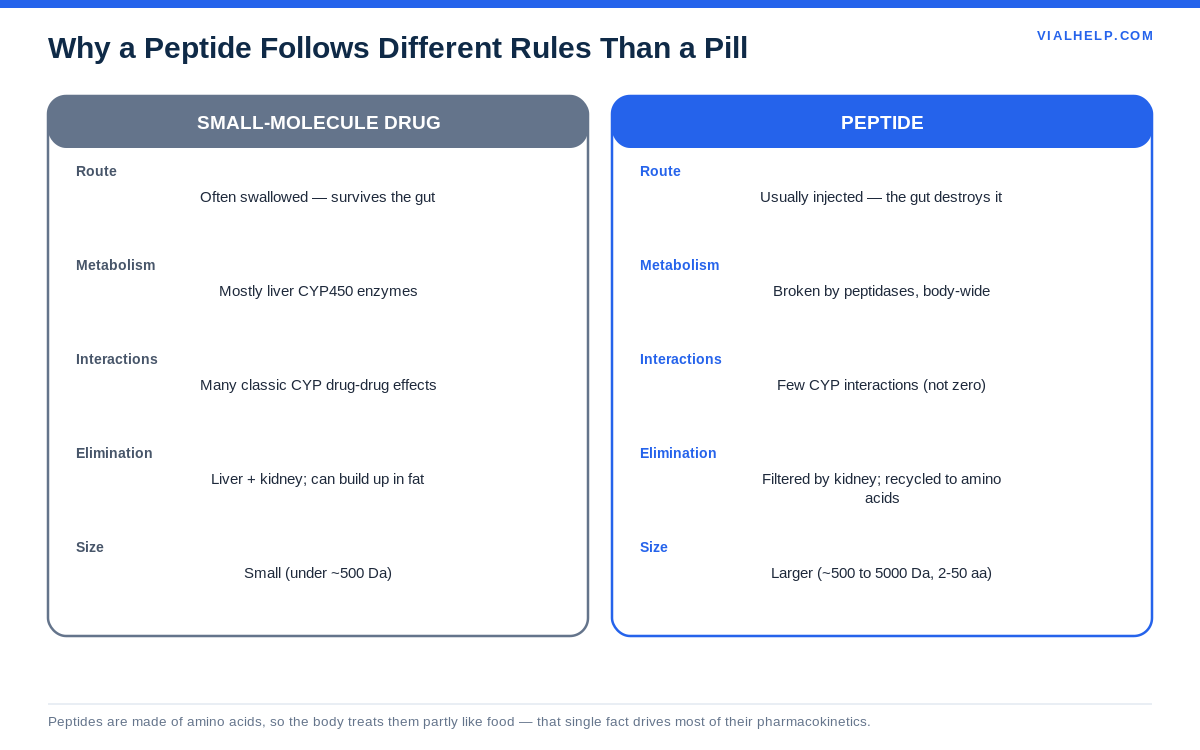
Peptide pharmacokinetics — what the body does to a peptide once it is in you — follows different rules than the pharmacokinetics of ordinary pills. The reason is simple: a peptide is a short chain of amino acids, so the body treats it partly like food. That one fact shapes how it is absorbed, where it goes, how it is broken down, and how fast it leaves.
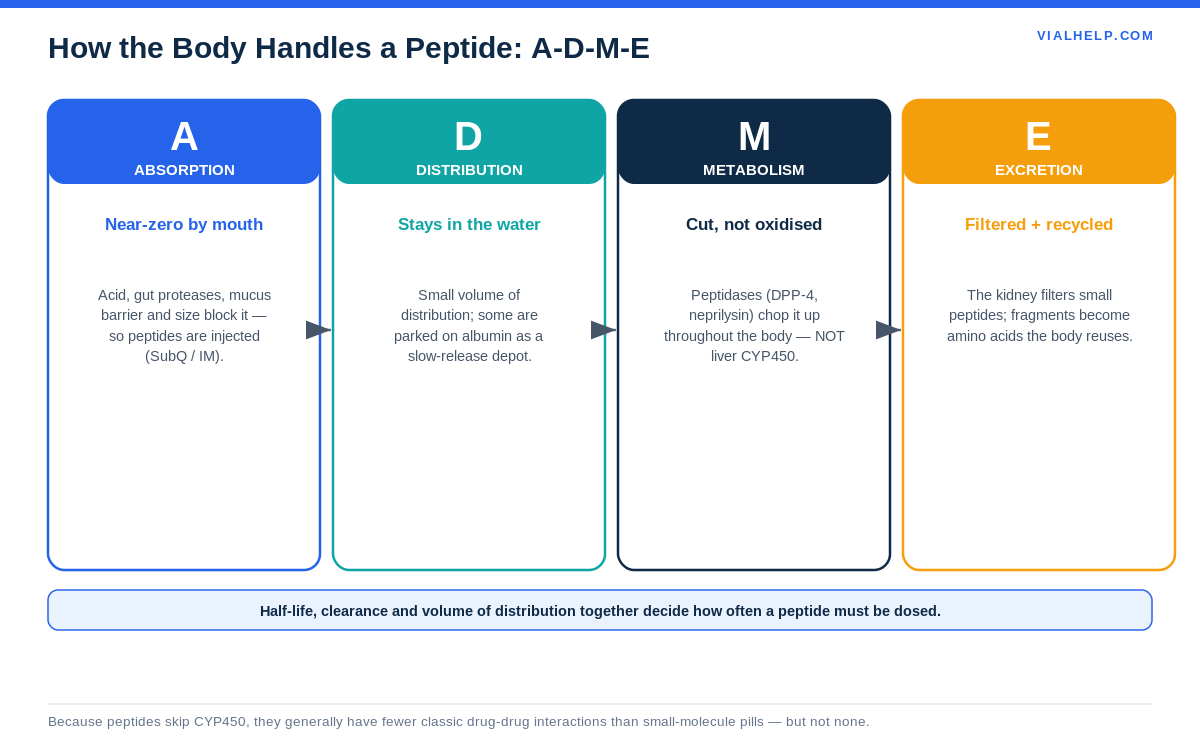
How the body handles a peptide: A-D-M-E
Pharmacologists summarize a drug’s journey with four letters — Absorption, Distribution, Metabolism, Excretion (ADME). Walking through them for a peptide explains most of what makes these compounds behave the way they do.
Absorption: why peptides are injected, not swallowed
Swallow an unmodified peptide and very little survives. Stomach acid, digestive proteases, the mucus layer and the tight intestinal wall all work against it, and its size and water-loving surface block passive absorption. The result is near-zero oral bioavailability. That is why most peptides are injected (subcutaneously or intramuscularly) rather than taken as tablets.
There are engineered exceptions. Oral semaglutide is co-formulated with an absorption enhancer (SNAC) that shields it in the stomach and helps a little across the lining — but even then, absolute bioavailability is under one percent (about 0.8%). It is the exception that proves the rule; for the full story see why peptides aren’t pills.
Distribution: staying in the water
Once in the bloodstream, hydrophilic peptides tend to stay in the body’s watery compartments rather than soaking into fat or flooding into cells — so their volume of distribution is usually small. Most also do not freely cross cell membranes or the blood-brain barrier without help.
Distribution is also where clever engineering shows up. Attaching a fatty acid lets a peptide cling reversibly to albumin, the most abundant blood protein, creating a slow-release reservoir in the circulation. That is exactly how semaglutide and liraglutide are protracted, and a similar idea underlies the DAC on CJC-1295.
Metabolism: cut, not oxidised
This is the biggest departure from small-molecule drugs. Ordinary pills are largely metabolized by liver CYP450 enzymes. Peptides mostly are not. Instead they are taken apart by peptidases and proteases — enzymes like DPP-4 and neprilysin — that work throughout the body: in blood, on the vessel wall, in the kidney and liver and other tissues. The peptide is chopped into fragments and amino acids, which are simply recycled into the body’s amino-acid pool. (This is the controlled, enzyme-driven version of the broader story in how peptides break down.)
One practical consequence: because peptides sidestep CYP450, they generally have fewer of the classic drug-drug interactions that small molecules do — though not none, since effects like delayed gastric emptying can still alter how other oral drugs are absorbed.
Excretion: filtered and recycled
For small peptides, the kidney is a major exit. They are filtered at the glomerulus and then broken down and reabsorbed as amino acids in the tubules. Very small peptides therefore clear quickly. Larger ones — and those bound to albumin — are too big to filter easily, so they linger, which is another reason albumin binding stretches a peptide’s stay in the body.
The numbers that matter (and tie back to dosing)
A few parameters capture all of this. Half-life is how long it takes the blood level to fall by half — the main driver of how often a peptide is dosed. Clearance is how fast the body removes it. Volume of distribution describes how widely it spreads. Bioavailability is the fraction that reaches circulation intact (100% for an IV dose, under 1% for an oral peptide). And steady state — roughly four to five half-lives of repeated dosing — is when levels plateau. A short half-life means frequent dosing; a long one can mean weekly. If you want to see how half-life shapes a schedule, the half-life explainer and the reconstitution calculator put the same relationships into numbers.
Buying time: half-life extension
Because native peptides clear so fast, much of peptide engineering exists to slow them down:

- Fatty-acid acylation — bind reversibly to albumin (liraglutide, semaglutide).
- DAC / covalent albumin binding — bond permanently to albumin so the complex is too large to filter (CJC-1295 with DAC).
- PEGylation — add a polymer chain to enlarge the molecule and slow filtration.
- Protease-resistant backbone — non-natural residues (Aib, D-amino acids) or cyclization that peptidases cannot grip.
Frequently asked questions
Why can’t peptides be taken as pills?
The gut is built to digest proteins. Acid, proteases and the intestinal barrier destroy or block most peptides, leaving almost nothing absorbed — so they are injected instead. A handful use special absorption enhancers to achieve very low oral bioavailability.
Are peptides processed by the liver like other drugs?
Not in the usual CYP450 sense. The liver contributes, but peptides are mainly broken down by peptidases spread throughout the body, then recycled as amino acids.
Do peptides have drug interactions?
Generally fewer of the classic CYP-based ones, because they skip that pathway. But interactions still exist — for example, GLP-1 agonists slow gastric emptying, which can change the absorption of co-taken oral drugs.
Why do some peptides dose weekly and others daily?
Half-life. Native peptides often clear in minutes; engineered ones bound to albumin or PEGylated can last days, allowing weekly dosing. It is the single biggest driver of dosing frequency. This is background pharmacology, not dosing advice.
References
- Diao L, Meibohm B. Strategic approaches to optimizing peptide ADME properties. AAPS J. 2014;16(6):1214–1230. PMC4287298
- Systemic pharmacokinetic principles of therapeutic peptides. Clin Pharmacokinet. 2025. doi:10.1007/s40262-025-01615-z
- Current understanding of SNAC as an absorption enhancer: the oral semaglutide experience. Clin Diabetes. 2024;42(1):74–86. diabetesjournals.org
- Molecular mechanisms of semaglutide and liraglutide. Front Nutr. 2024;11:1398059. frontiersin.org
- Teichman SL, et al. Prolonged stimulation of GH and IGF-I by CJC-1295 in healthy adults. J Clin Endocrinol Metab. 2006;91(3):799–805. PMID 16352683
- Semaglutide (Ozempic) FDA prescribing information. FDA label
Informational only — not medical advice · 21+. VialHelp does not sell or recommend peptides. Nothing here is a dosing recommendation.