
Substance P and the Tachykinins Explained
Peptide biology
Substance P is one of the body’s best-known signalling peptides — an 11-amino-acid messenger that sensory nerves use to shout “pain,” to inflame tissue, and to trigger the vomiting reflex. It heads a family called the tachykinins, and its receptor has taken drug developers on a surprising round trip from failed antidepressant to pharmacy-shelf anti-nausea drug.
What is substance P?
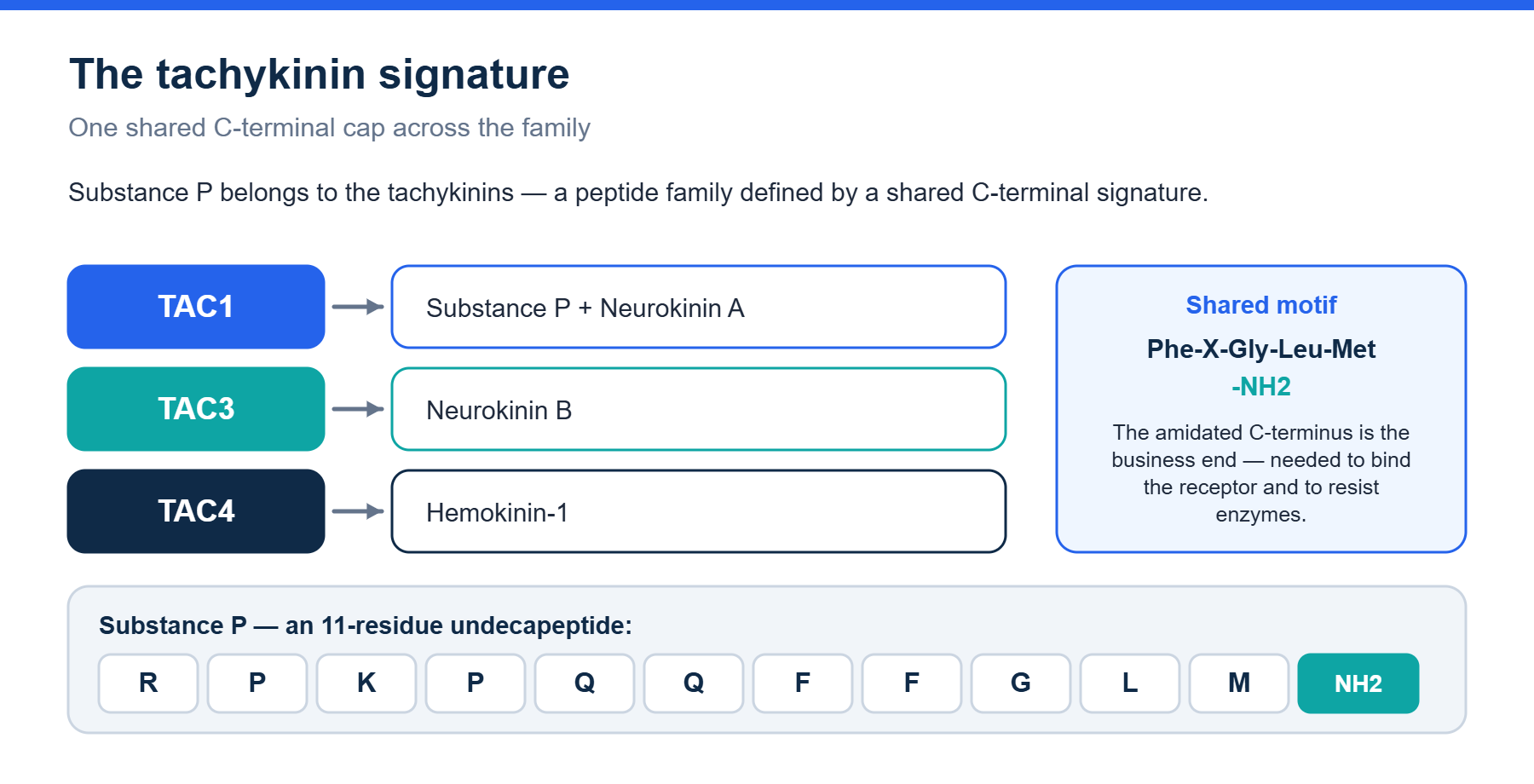
Substance P is an undecapeptide — eleven amino acids, Arg-Pro-Lys-Pro-Gln-Gln-Phe-Phe-Gly-Leu-Met, ending in an amide (RPKPQQFFGLM-NH2). It is encoded by the TAC1 gene and released mainly by sensory (afferent) nerves. That amidated C-terminus is not decorative: together with the peptide’s two prolines it is the “business end” that binds the receptor and helps the molecule resist enzymes.
The tachykinin family
Substance P belongs to the tachykinins, a family defined by a shared C-terminal motif, Phe-X-Gly-Leu-Met-NH2. The TAC1 gene produces both substance P and neurokinin A; TAC3 produces neurokinin B; and TAC4 produces hemokinin-1. Because they share that C-terminal signature, the tachykinins can cross-activate one another’s receptors, though each has a preferred partner.
The receptors: NK1, NK2 and NK3
The tachykinins act through three class A G-protein-coupled receptors — NK1, NK2 and NK3 — that signal mainly through the Gq/phospholipase-C pathway. Substance P prefers NK1, neurokinin A prefers NK2, and neurokinin B prefers NK3. As with most peptide systems, “prefers” is the operative word; the pairings are tendencies rather than strict locks.
What substance P does
Substance P is a workhorse of the sensory nervous system with a strikingly wide reach.
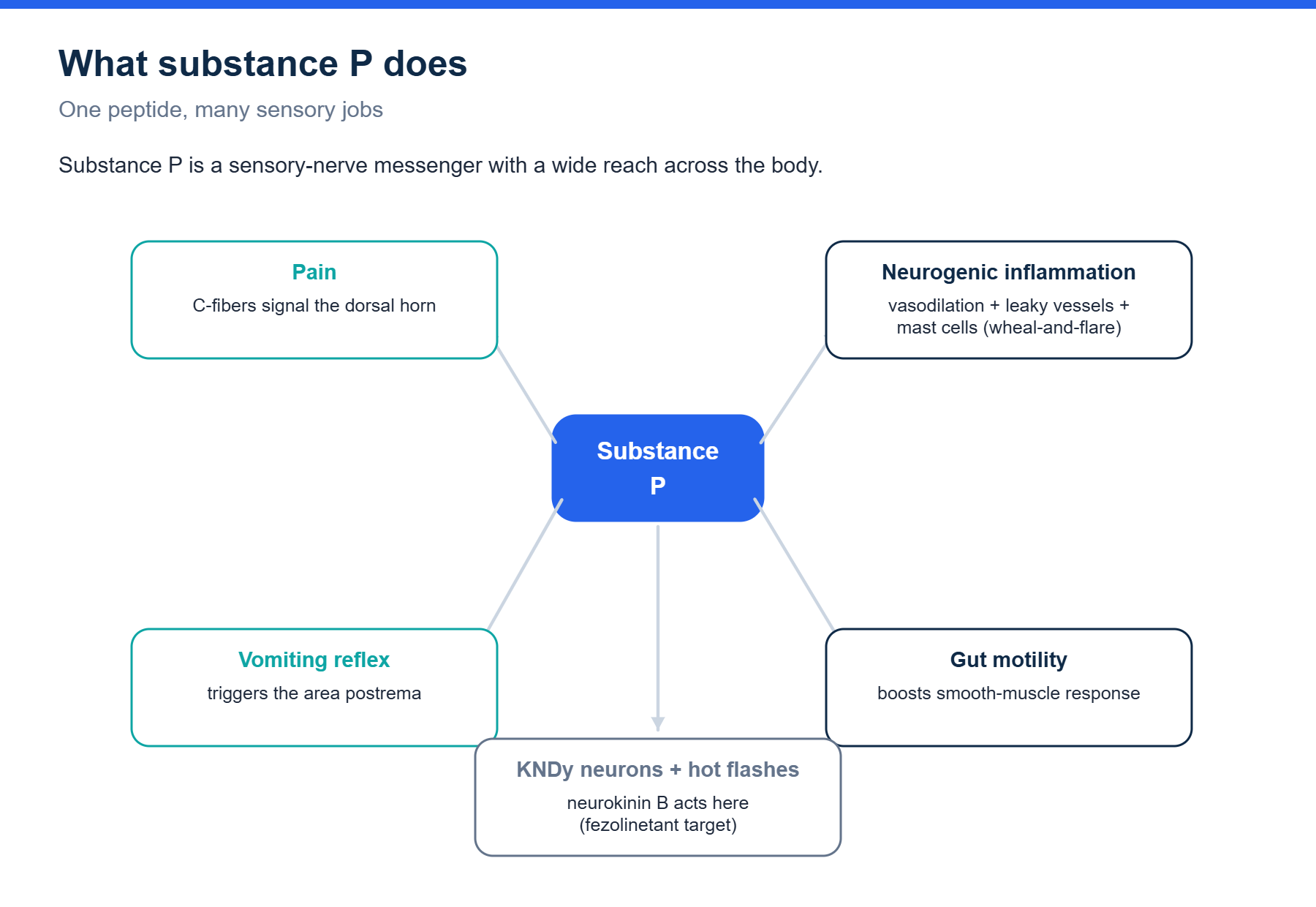
It is released by pain-carrying C-fibers in the spinal cord, sensitising the neurons that relay pain signals. In tissue it drives neurogenic inflammation — widening blood vessels, making them leaky, and nudging mast cells to degranulate, producing the familiar wheal-and-flare. In the brainstem’s vomiting centre it helps trigger emesis (which is why it became a drug target for chemotherapy nausea), and it also influences gut motility. Neurokinin B, its cousin, acts on NK3 receptors in the hypothalamic KNDy neurons that help set reproductive hormone pulses and body temperature — a circuit tied to the reproductive (HPG) axis and to menopausal hot flashes.
From failed antidepressant to anti-nausea win
Blocking the NK1 receptor looked, on paper, like a promising way to treat depression. It was not: large Phase III trials failed to beat placebo, and NK1 blockers disappointed as analgesics too. The concept was largely abandoned for those uses.

Then the same drugs found a second life. NK1-receptor antagonists — aprepitant, fosaprepitant, netupitant and rolapitant — are now standard anti-nausea agents for chemotherapy, especially effective against the delayed phase. And a cousin drug, the NK3 antagonist fezolinetant (approved in 2023), eases menopausal hot flashes by acting on those KNDy neurons. One family of receptor blockers, two very different clinical destinations.
How substance P is switched off
Like other signalling peptides, substance P is meant to act briefly and then disappear. It is broken down by peptidases including neprilysin in tissue and angiotensin-converting enzyme (ACE) in plasma — the same ACE that features in our kallikrein-kinin (bradykinin) story. Its lifetime is short: seconds to minutes in tissue, somewhat longer in the blood.
Frequently asked questions
What is substance P responsible for?
It is a sensory-nerve messenger involved in pain signalling, neurogenic inflammation, the vomiting reflex and gut motility, among other roles.
Is substance P a tachykinin?
Yes. It is the best-known member of the tachykinin family, which shares a common C-terminal motif and signals through the NK1, NK2 and NK3 receptors.
What drugs block substance P?
NK1-receptor antagonists such as aprepitant are used to prevent chemotherapy-induced nausea and vomiting. They block substance P at its preferred receptor.
How is substance P broken down?
By peptidases — notably neprilysin in tissue and ACE in the bloodstream — which limit how long the signal lasts.
- Graefe S, et al. Biochemistry, Substance P. StatPearls (NBK554583)
- Antiemetic Neurokinin-1 Receptor Blockers. StatPearls (NBK470394)
- UniProt P20366 — Protachykinin-1 (TAC1)
- PubChem CID 36511 — Substance P (C63H98N18O13S)
- IUPHAR/BPS Guide to Pharmacology — Tachykinin receptors
- NK1 receptor antagonists for depression: why a validated concept was abandoned (PMID 28753469)
Informational only — not medical advice · 21+. This article summarizes published science for educational purposes. It is not medical guidance or a recommendation to use any substance. Consult a qualified healthcare professional for medical concerns.