
Common Peptide Reconstitution Mistakes (and How to Avoid Them)
Handling & technique · informational
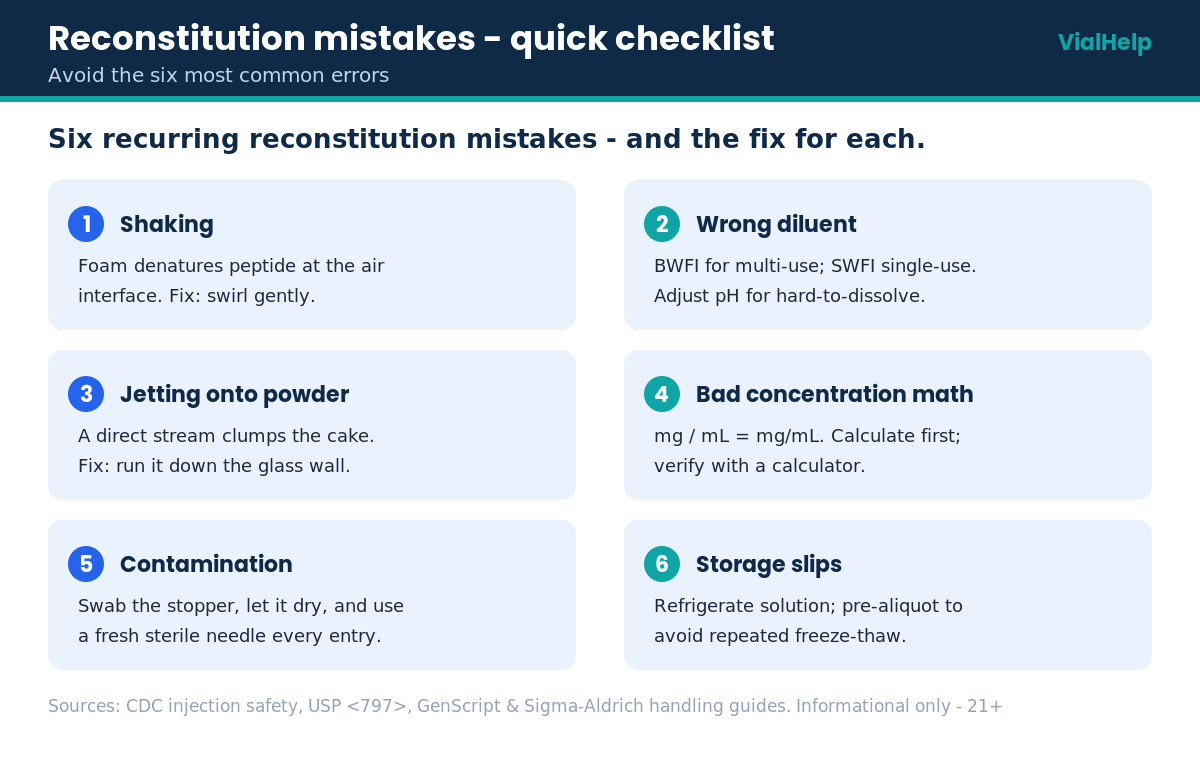
Most peptide reconstitution mistakes come down to a handful of avoidable habits — shaking the vial, grabbing the wrong water, jetting diluent onto the powder, or fumbling the concentration math. Here are the six that matter most and the correct technique for each.
Reconstituting a lyophilized (freeze-dried) peptide looks simple, but small handling errors can quietly degrade the material or throw off every measurement that follows. The fixes below are standard lab-handling practice, framed for a research context.
1. Shaking the vial
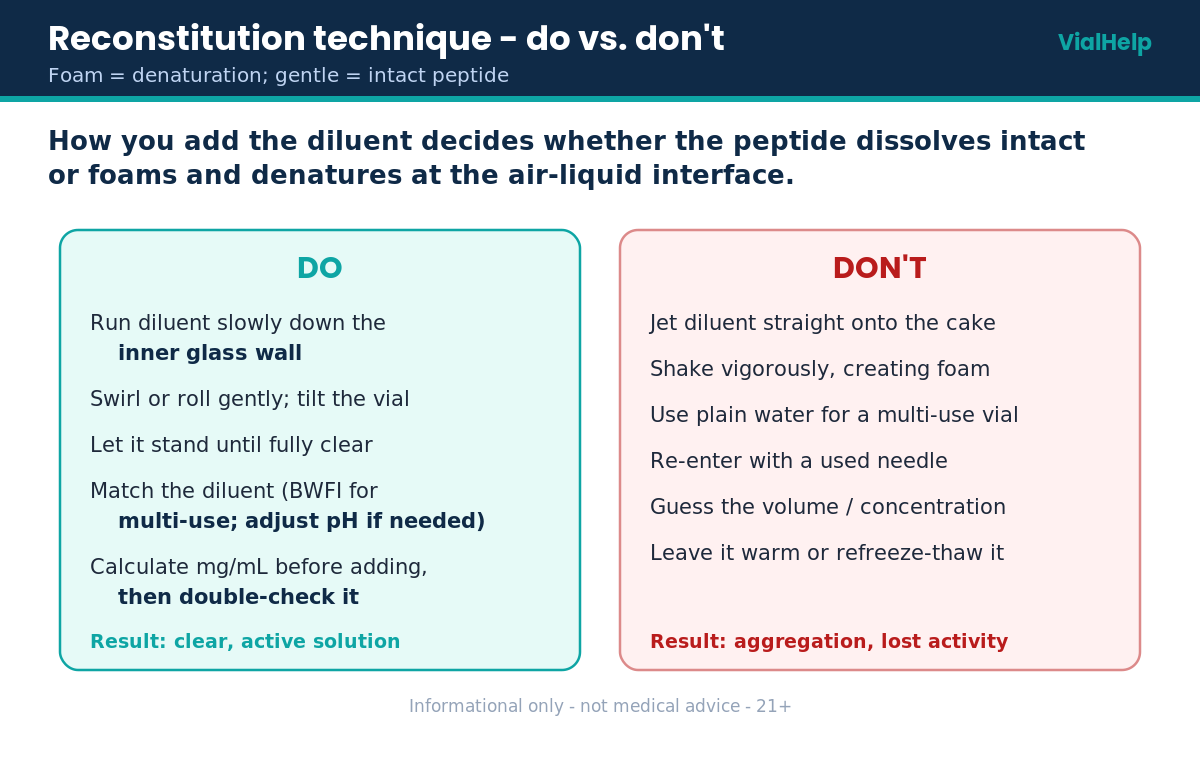
Shaking to “speed things up” is the most common reconstitution mistake. It whips air into the solution and forces the peptide through repeated air-liquid interfaces. Peptides and proteins are surface-active: at that interface they partially unfold, and the agitation drives aggregation and particle formation. The damage is mainly interfacial, and it is effectively irreversible — aggregated peptide loses activity. Fix: dissolve by gentle swirling, slow rolling between the palms, or slow tilting; let it stand until clear.
2. Using the wrong diluent
Not all “water” is interchangeable. Sterile Water for Injection (SWFI) has no preservative and is meant for single use. Bacteriostatic Water for Injection (BWFI) contains about 0.9% benzyl alcohol, which inhibits bacterial growth and makes it appropriate for a vial entered more than once (commonly cited as good for up to 28 days when stored properly). Solubility matters too: some peptides dissolve poorly in plain water and need a slightly acidic or basic vehicle. Fix: match the diluent to the use pattern and the peptide, and test a small aliquot before committing the whole vial. The bacteriostatic water guide covers the differences.
3. Jetting diluent straight onto the powder
Aiming a fast stream of diluent directly at the lyophilized cake causes localized turbulence, foaming and clumping — the same denaturation pathway as shaking, just at the moment of contact. Fix: tilt the vial and let the diluent run slowly down the inner glass wall so it wets the cake gently, then swirl to dissolve. This is the single most repeated instruction across reconstitution guides; see how to reconstitute peptides.
4. Getting the concentration math wrong
Adding an arbitrary volume and then losing track of the concentration is a frequent and consequential error. The relationship is simply:
Fix: decide the target concentration first, back-calculate the volume, measure it precisely, and verify the result with the reconstitution calculator or the concentration converter before you add solvent.
5. Poor aseptic technique / contamination
Skipping stopper disinfection, coring the rubber stopper, or re-entering with a used needle all invite contamination. CDC and USP guidance is consistent: swab the rubber stopper with a fresh alcohol pad before every entry and let it dry; use a sterile needle and syringe each time; and date a multi-dose vial, discarding it within 28 days (or sooner if sterility is ever in doubt). To avoid coring, enter bevel-up at an angle and rotate to vertical as the needle passes through. Fix: follow sterile technique every time.
6. Temperature and storage slips
Reconstitution reintroduces water and reactivates every degradation pathway, so shelf life drops from months (lyophilized) to days or weeks (in solution). Leaving the reconstituted vial at room temperature or subjecting it to repeated freeze-thaw cycles both accelerate loss of activity — freeze-thaw damage is cumulative. Fix: refrigerate the reconstituted solution at 2–8°C, and pre-aliquot into single-use portions before freezing so each is thawed only once. See peptide storage and stability.
Frequently asked questions
Why can’t I just shake the vial to dissolve it faster?
Shaking foams the solution and unfolds the peptide at the air-liquid interface, which causes aggregation and lost activity. Gentle swirling dissolves it without that damage.
Which water should I use?
Bacteriostatic water for anything entered more than once; sterile water for single use. Some hard-to-dissolve peptides need a pH-adjusted vehicle.
How do I know the concentration?
Divide the milligrams of peptide by the millilitres of diluent. A calculator helps you verify before you add solvent.
How should I store the reconstituted vial?
Refrigerate at 2–8°C and avoid repeated freeze-thaw by pre-aliquoting before freezing.
- Interfacial stress in the development of biologics (AAPS Journal, PMC6435788). link
- CDC — Preventing unsafe injection practices. link
- USP General Chapter <797> Pharmaceutical Compounding — Sterile Preparations. link
- GenScript — Peptide storage and handling guidelines. link
- Sigma-Aldrich — Handling and storage guidelines for peptides and proteins. link
- Vial coring after angled penetration of rubber stoppers (De Gruyter). link
Informational only. This guide is for educational and laboratory/measurement purposes and is not medical advice. It does not recommend or instruct personal human use. Consult a qualified healthcare professional for any health decision. Content is intended for adults 21+. Verify scientific details against the primary sources cited.