
Glass vs Plastic Storage Containers for Peptides
Choosing glass vs plastic for storing peptide solutions is about more than breakage. Peptides can stick to container walls — a process called adsorption — and the material you choose affects how much of your peptide actually stays in solution.
The hidden problem: peptide adsorption
Peptides and proteins in solution tend to adsorb onto the surfaces of tubes, vials and pipette tips. The loss is worst in dilute solutions: a fixed amount of surface binding removes a much larger fraction of the peptide when little is present. In one peer-reviewed study of cationic peptides, only about 10–20% of the expected peptide was recovered from polypropylene tubes at a 1 µM concentration — meaning roughly 80–90% had stuck to the walls. Recovery improved as concentration rose, because the surface binding sites became saturated.
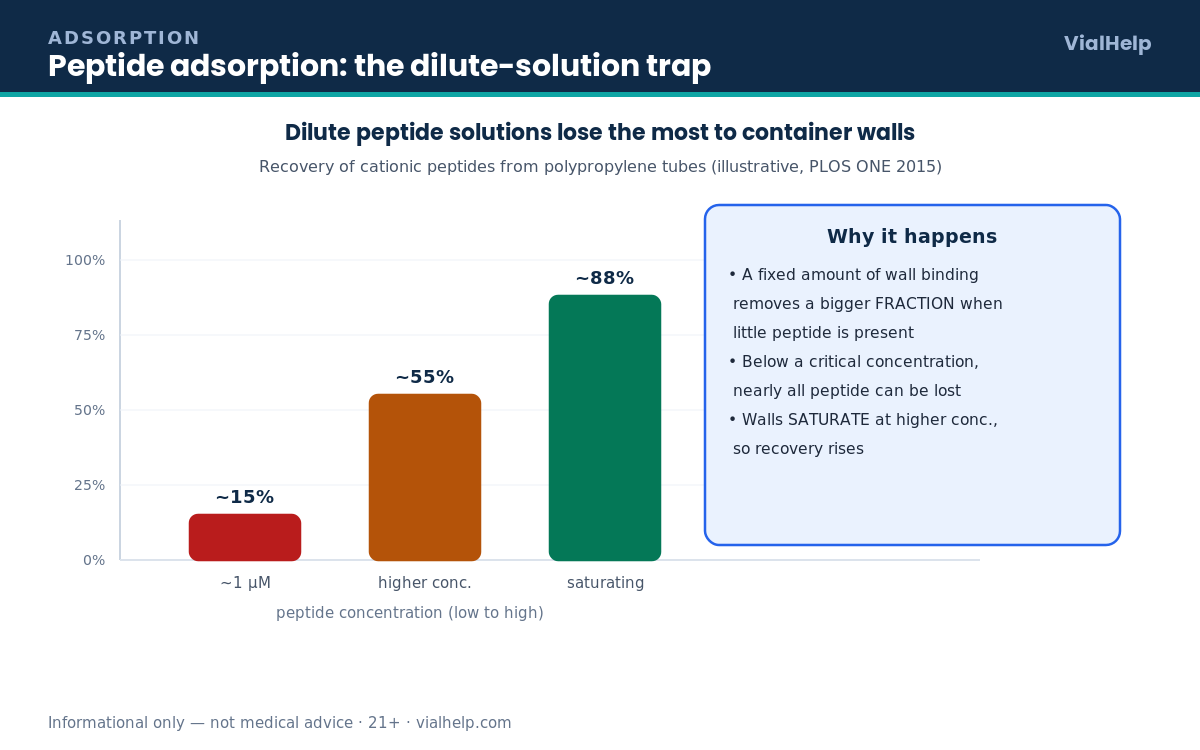
Below a certain “critical concentration,” essentially all of a peptide can be lost to surfaces — quietly distorting any measurement that follows.
Glass vs plastic: the tradeoffs
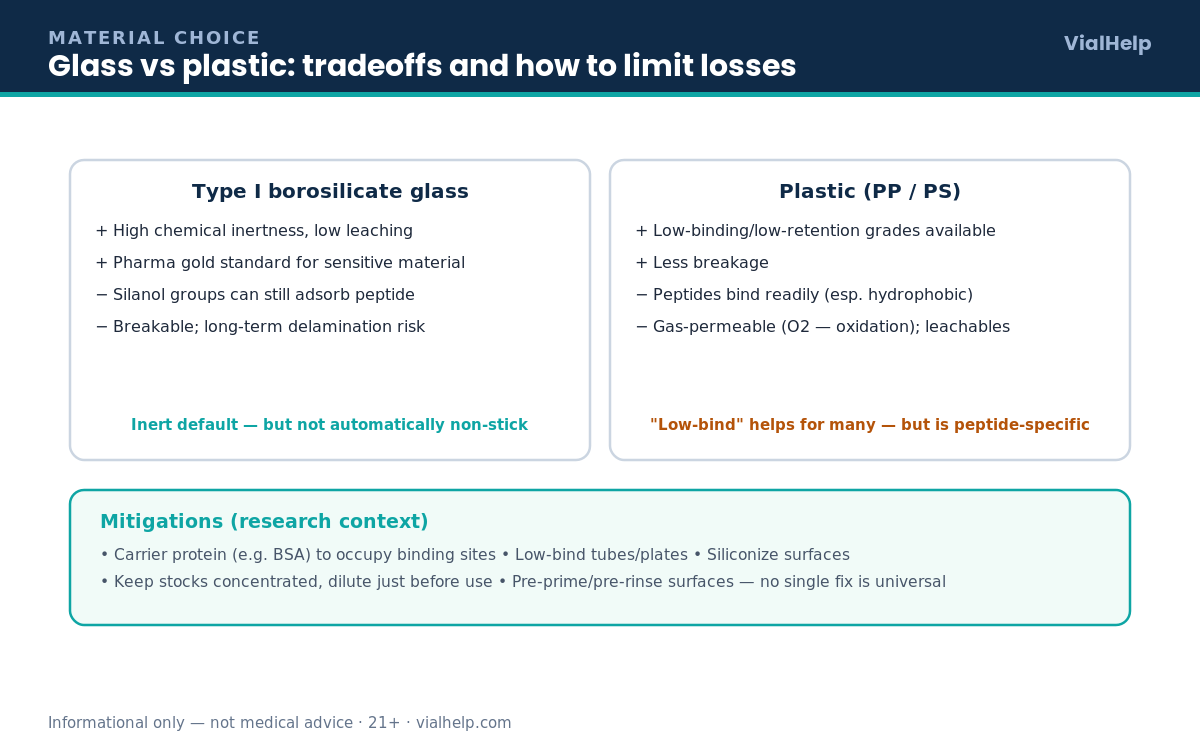
Type I borosilicate glass is the pharmaceutical gold standard for chemical inertness and low leaching. It is the safe default for sensitive material — but it is not automatically “non-stick”: surface silanol groups can still adsorb peptides (cationic peptides are actually attracted to negatively charged glass). Glass is also breakable and, over long storage, can shed silica flakes (delamination).
Plastics such as polypropylene (PP) and polystyrene (PS) are less breakable and are available in “low-binding” grades that reduce adsorption for many analytes. The catch is that peptides — especially hydrophobic ones — can bind readily to untreated plastic, plastics are more gas-permeable (oxygen ingress can drive oxidation), and they may contribute leachables.
USP glass classifications
For context, USP General Chapter <660> classifies glass by its hydrolytic resistance: Type I (borosilicate, high resistance, low extractables), Type II (surface-treated soda-lime) and Type III (untreated soda-lime, moderate resistance). Plastic packaging systems are covered separately under USP <661>. Type I borosilicate is the inert choice for storing sensitive solutions.
How to limit losses
Whatever container you use, several research-context measures reduce adsorption losses:
- Use a carrier protein (such as BSA) to “sacrificially” occupy binding sites — a research additive, not appropriate for every use.
- Choose low-binding tubes and plates.
- Siliconize surfaces to reduce binding.
- Keep stocks more concentrated and dilute just before use.
- Pre-prime or pre-rinse surfaces so your working sample isn’t depleted.
None of these is a universal fix — pick the approach that suits the peptide and the measurement. Pairing this with good preparation helps: the reconstitution calculator keeps your concentrations consistent, and the storage and stability guide covers the rest.
Frequently asked questions
Do peptides stick more to glass or plastic? It depends on the peptide. Hydrophobic peptides often bind plastic; cationic peptides are attracted to glass. There is no single answer, which is why mitigations matter more than the material alone.
What is a low-binding tube? A tube made or treated to reduce protein and peptide adsorption to its walls. It improves recovery for many peptides, but results are peptide-specific.
Does adding BSA help? In research, a carrier protein like BSA can substantially improve recovery by occupying binding sites. It introduces a foreign protein, so it is only appropriate where that does not interfere with the work.
References
- Kraft GA, et al. “Adsorption of cationic peptides to solid surfaces of glass and plastic.” PLOS ONE, 2015. PMC4416745
- “Enhanced recovery of low-concentration protein and peptide solutions on ultra-low-binding microplates.” PMC6391626
- “Adsorption of surfactant protein D to polypropylene and its prevention.” PLOS ONE, 2013. PMC3770593
- USP General Chapter <660> Containers—Glass (Type I/II/III hydrolytic resistance). USP
Informational only — not medical advice · 21+