
What Is Neuropeptide Y? The Hunger Signal That Failed as a Drug Target
Guides · Peptide biology
Neuropeptide Y is one of the most potent appetite-stimulating peptides ever identified, and it is also one of the most instructive failures in obesity drug development. It is a 36-amino-acid messenger, made mostly by neurons, that sits on the hunger side of a two-neuron argument in the hypothalamus. Inject it into a rodent brain and the animal eats. Delete it entirely and, remarkably, very little happens. Two pharmaceutical companies spent years and thousands of trial participants trying to block it, and neither produced a drug. That gap — between a powerful signal and a useful target — is the real story here.
What neuropeptide Y is
Neuropeptide Y is 36 amino acids long, capped with an amide at its tail end, and unusually rich in tyrosine — which is where the Y comes from, tyrosine being Y in the single-letter code. Its sequence is YPSKPDNPGEDAPAEDMARYYSALRHYINLITRQRY. The human gene sits on chromosome 7 and the protein is catalogued under UniProt accession P01303; its molecular formula, C189H285N55O57S, works out to a mass of roughly 4,270 daltons.
It belongs to a family of three closely related 36-residue peptides that all fold into the same hairpin shape, known as the PP-fold: neuropeptide Y itself, peptide YY (PYY), and pancreatic polypeptide (PP). The division of labour is clean. Neuropeptide Y is a neurotransmitter; PYY and PP behave as hormones. In the peripheral nervous system, neuropeptide Y is found predominantly in sympathetic neurons; within the brain, concentrations are highest in the hypothalamus, brain stem and anterior pituitary.
The circuit it belongs to
The most studied population of neuropeptide Y neurons lives in the arcuate nucleus of the hypothalamus, a region that sits outside the normal blood-brain barrier and can therefore sample what is circulating in the blood. These neurons also make agouti-related protein (AgRP) and release the inhibitory neurotransmitter GABA. Opposite them sit the POMC and CART neurons, which release alpha-MSH, the satiety signal.
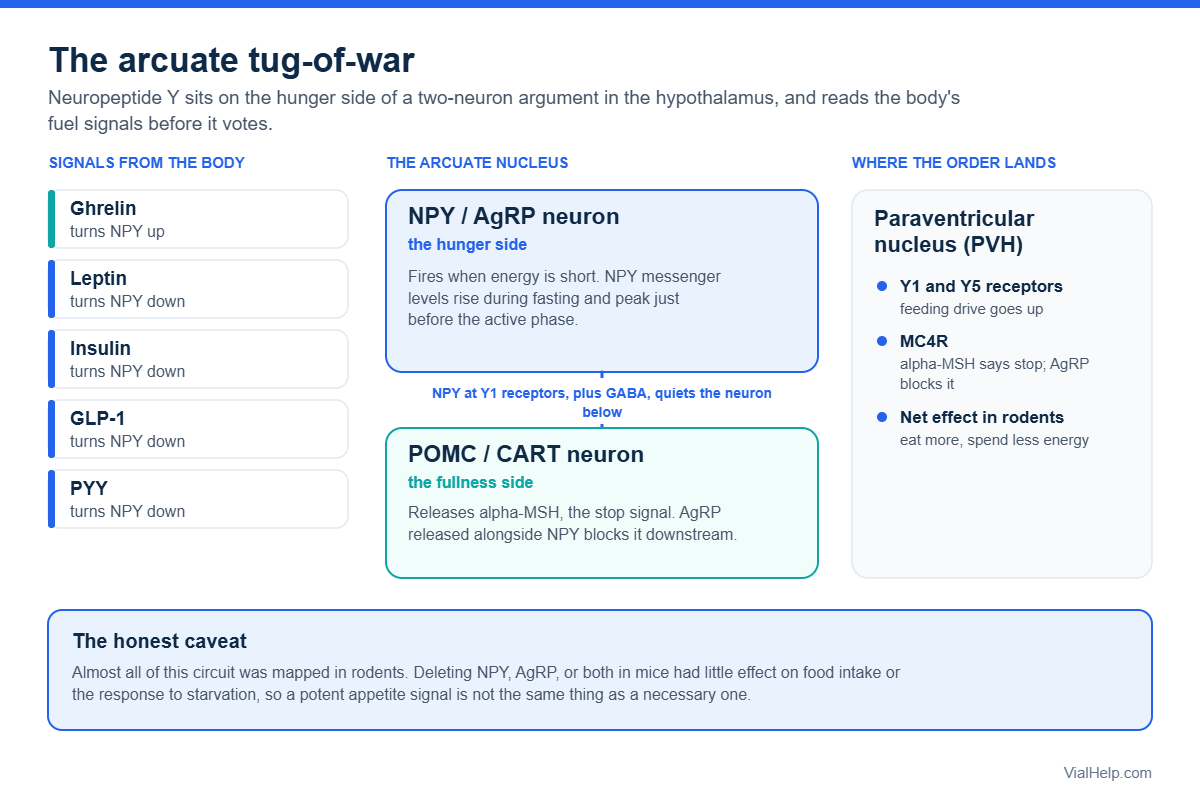
The hunger neurons win arguments in several ways at once. Neuropeptide Y acts on Y1 receptors on the POMC and CART neurons to quieten them; the co-released GABA does the same; and downstream, AgRP blocks alpha-MSH at the melanocortin-4 receptor so the stop signal never lands. Meanwhile neuropeptide Y acting on Y1 and Y5 receptors in the paraventricular nucleus drives feeding directly. If you have read our piece on melanocortin receptors, this is the other half of that circuit.
What turns the system up and down is a familiar cast. Fasting raises neuropeptide Y messenger RNA in the arcuate nucleus, and levels follow a daily rhythm, peaking shortly before the active phase begins. Ghrelin, the hunger hormone, increases neuropeptide Y expression. Leptin, insulin, GLP-1 and PYY all reduce it. The arcuate neurons carry receptors for insulin, leptin and ghrelin directly, so this is not an indirect story.
The receptors, and the one that is a ghost
Four functional receptors exist in humans: Y1, Y2, Y4 and Y5. All are class A G protein-coupled receptors, all couple to Gi or Go proteins and inhibit adenylyl cyclase, and all are numbered in a way that betrays a messy history.
- Y1 and Y5 drive feeding in the paraventricular nucleus. Y1 also mediates the vasoconstriction that neuropeptide Y produces in blood vessels.
- Y2 acts largely as a presynaptic autoreceptor, damping further release — a brake rather than an accelerator.
- Y4 prefers pancreatic polypeptide over neuropeptide Y, and the human gene shows extensive copy-number variation between individuals.
- There is no Y3. The slot in the nomenclature was deliberately left empty because the evidence for a distinct Y3 site was circumstantial and it was never cloned.
- Y6 is a pseudogene in humans. It is functional in mice and rabbits, but not in primates — a useful reminder when reading rodent papers.
The DPP-4 switch
One of the neatest pieces of biology here concerns an enzyme that peptide readers will already know. DPP-4, also called CD26, removes the first two amino acids from neuropeptide Y, producing NPY(3-36).
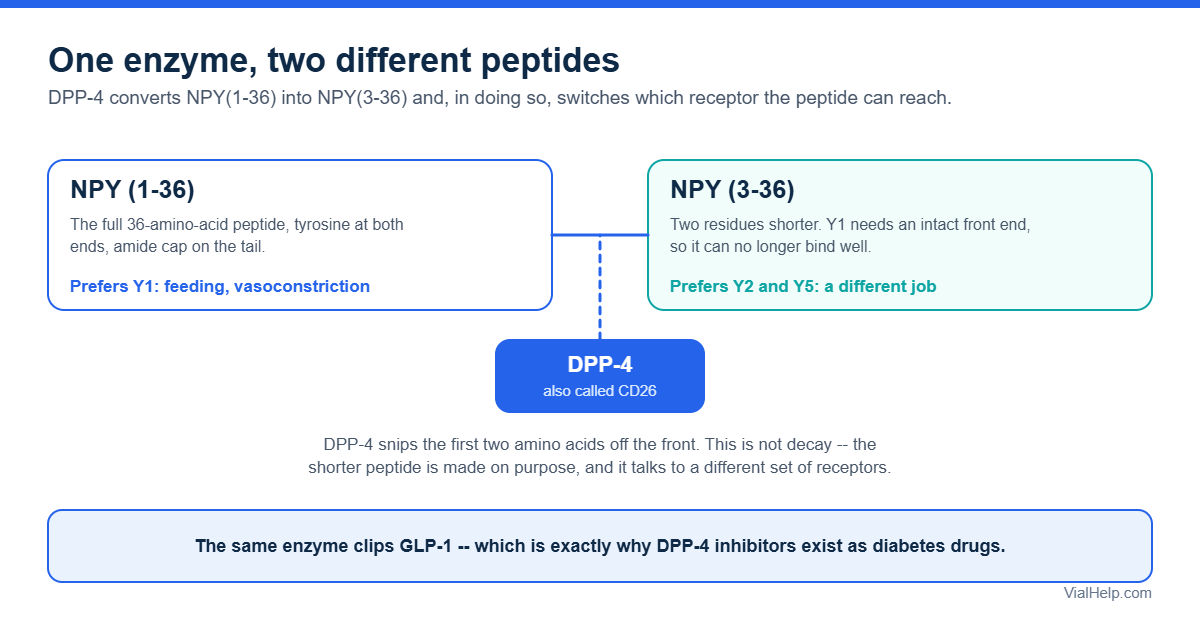
This is not decay. As the international pharmacology nomenclature explicitly notes, the shortened forms are not mere degradation products but are actively formed by DPP-4. The consequence is a change of address: Y1 requires an intact front end, so it binds the shortened peptide poorly, while Y2 and Y5 are potently activated by it. The same enzyme performs the same trick on PYY, producing the Y2-preferring PYY(3-36), and on GLP-1 — which is precisely why DPP-4 inhibitors exist as diabetes drugs. One enzyme, three peptides, three different consequences. For the broader picture, see how peptides are broken down.
What neuropeptide Y does beyond appetite
Feeding is the headline, but the catalogue of attributed effects is long: presynaptic inhibition of neurotransmitter release both centrally and peripherally, reduction of anxiety in the central nervous system, modulation of circadian rhythm, pituitary hormone release, effects in the hippocampus, pain transmission, vasoconstriction, inhibition of insulin release, and renal function. The vasoconstrictor role was in fact recognised early, in work from the early 1980s on sympathetic constriction that persisted despite alpha-adrenoceptor blockade.
What happened when drug companies targeted it
If a peptide reliably makes animals eat, blocking it should make people eat less. That reasoning drove two serious programmes, and neither worked.
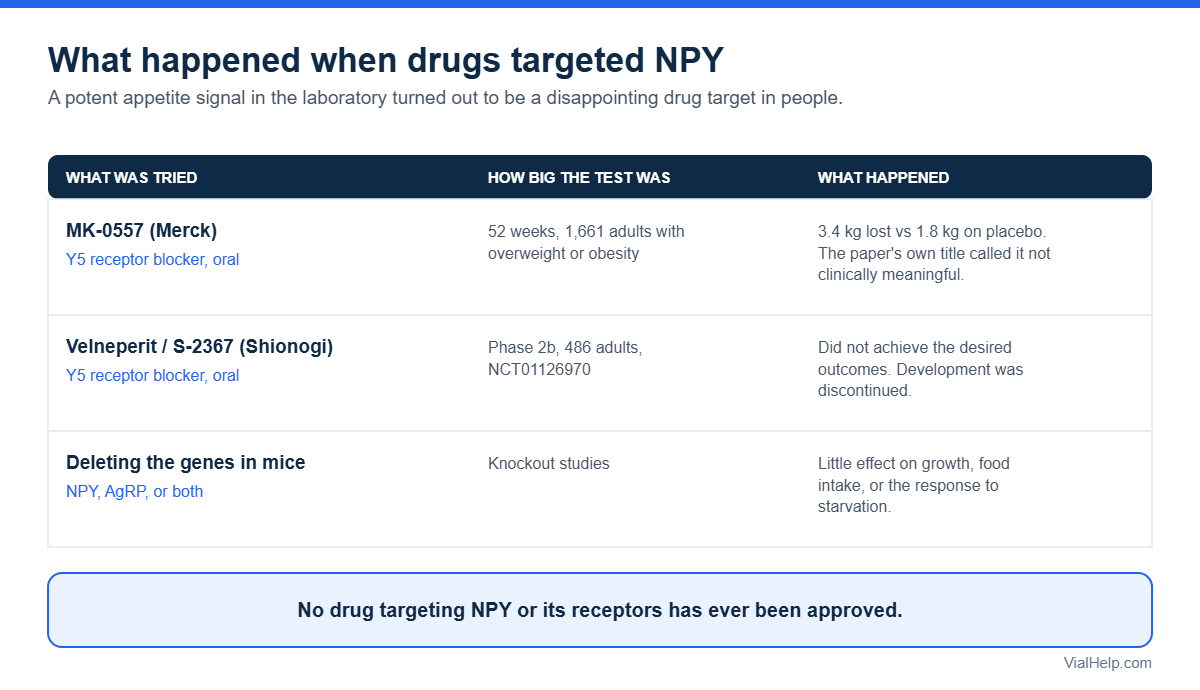
Merck took MK-0557, a Y5 receptor antagonist, into a 52-week randomised, double-blind, placebo-controlled trial in 1,661 overweight and obese adults. Participants on the drug lost 3.4 kg against 1.8 kg on placebo. The published paper carried its own verdict in the title: neuropeptide Y5 receptor antagonism does not induce clinically meaningful weight loss in overweight and obese adults.
Shionogi took velneperit (S-2367), also a Y5 antagonist. A phase 2a study in 342 people with obesity produced average weight loss of 5.3 kg at the highest dose against 2.5 kg on placebo — encouraging enough to continue. A phase 2b trial in 486 participants, testing velneperit alone and combined with orlistat, failed to achieve the desired outcomes. Development was discontinued; the US National Center for Advancing Translational Sciences still lists the compound as investigational, with development halted.
The mechanistic post-mortem had already been written. In 2002, work in Diabetes showed that a highly selective Y5 antagonist blocked feeding driven by a selective Y5 agonist, but had no significant effect on feeding driven by neuropeptide Y itself or by a 24-hour fast, and no effect on body weight with chronic dosing. A commentary in Nature Reviews Drug Discovery asked whether this was a dead end for Y5 antagonists, and noted that earlier compounds had suppressed feeding even in mice lacking the Y5 receptor entirely — a fairly conclusive sign of off-target activity.
What about neuropeptide Y in humans?
Direct human experience with the peptide is thin. The best-documented study is a 2018 randomised dose-ranging trial in posttraumatic stress disorder, in which 26 participants were randomised and 24 completed a single-dose crossover of intranasal neuropeptide Y against placebo, at doses from 1.4 to 9.6 mg. It was well tolerated at every dose. On one anxiety scale there was a significant interaction favouring the peptide; on another, there was not. The authors concluded that further study was warranted — which remains the accurate summary.
The broader claim that low neuropeptide Y marks vulnerability to stress and high levels mark resilience is widely repeated, but the peripheral measurements underpinning it have been questioned, and it is better treated as an active hypothesis than an established biomarker.
Frequently asked questions
Is neuropeptide Y the same as peptide YY?
No, though they are close relatives. Both are 36 amino acids long, both are amidated, and both fold into the same PP-fold shape, along with pancreatic polypeptide. The functional difference is that neuropeptide Y acts as a neurotransmitter released from neurons, while PYY is a gut-derived hormone. DPP-4 shortens both, and in each case the shortened form shifts toward the Y2 receptor.
Does blocking neuropeptide Y cause weight loss?
Not usefully, on the evidence available. Two Y5 receptor antagonists were taken into substantial human trials and neither produced clinically meaningful weight loss; one trial title says so explicitly. Animal work suggests the Y5 receptor was probably the wrong choice, and that redundancy in the feeding circuits absorbs the loss of any single signal.
Why is there no Y3 receptor?
Because it was never cloned. Evidence for a distinct Y3 binding site was circumstantial, and rather than reassign the number, the nomenclature committee left the slot empty. Human Y6 is a separate curiosity: the gene exists but is a pseudogene in primates, though it is functional in some other mammals.
Can neuropeptide Y be taken as a supplement?
It is a 36-amino-acid peptide with a short lifetime in plasma and poor access to the brain from the bloodstream, which is why the one human trial used an intranasal route and why the pharmaceutical effort focused on small-molecule receptor blockers rather than on the peptide. There is no approved product, and no evidence base for personal use.
References
- Neuropeptide Y receptors: introduction. IUPHAR/BPS Guide to Pharmacology.
- Neuropeptide Y ligand record (structure and post-translational modification). IUPHAR/BPS Guide to Pharmacology.
- NPY neuropeptide Y [Homo sapiens] — Gene, NCBI (Gene ID 4852).
- Chen S, et al. Regulation of feeding-related behaviors by arcuate neuropeptide Y neurons. Endocrinology 2019;160:1411.
- Angelidi AM, et al. Novel noninvasive approaches to the treatment of obesity. Endocrine Reviews 2022;43:507.
- Erondu N, et al. Neuropeptide Y5 receptor antagonism does not induce clinically meaningful weight loss in overweight and obese adults. Cell Metabolism 2006;4:275-282.
- Sayed S, et al. Randomized dose-ranging study of neuropeptide Y in patients with posttraumatic stress disorder. Int J Neuropsychopharmacol 2018;21:3-11.
Informational only. This article is educational and is not medical advice. It does not recommend or instruct personal human use. Consult a qualified healthcare professional for any health decision. Content is intended for adults 21+. Verify scientific details against the primary sources cited.