
Reproductive Peptide Side Effects: Gonadorelin & Kisspeptin-10
Side effects series
Gonadorelin and kisspeptin-10 both act on the reproductive axis, and their side-effect profiles could hardly be less alike — because one has decades of supervised human use behind it and the other has almost none. This is the eleventh entry in our side-effects series, and it is an unusual one: the most important safety fact here is not a symptom. It is that the two compounds sit at opposite ends of the evidence scale, and the tidy side-effect tables circulating for the newer one are invented.
What these two compounds are
Gonadorelin is synthetic GnRH — a decapeptide with the same sequence as the hormone the hypothalamus releases to drive the pituitary. It reached patients as a diagnostic agent (Factrel, for assessing pituitary gonadotrope function) and as Lutrepulse, a pump-delivered treatment for inducing ovulation in women with hypothalamic amenorrhea. Both brands are discontinued; no gonadorelin product is currently marketed for human use in the US.
Kisspeptin-10 is a fragment of the KISS1 gene product and a ligand at KISS1R/GPR54 — arguably the master switch upstream of GnRH. Its importance is beyond dispute: loss-of-function mutations in KISS1R cause hypogonadotropic hypogonadism, and an activating mutation causes central precocious puberty. But it is investigational only, approved nowhere, and the FDA placed it in 503A Category 2 — bulk drug substances that raise significant safety risks — in September 2023.
The mechanism that makes schedule matter more than dose
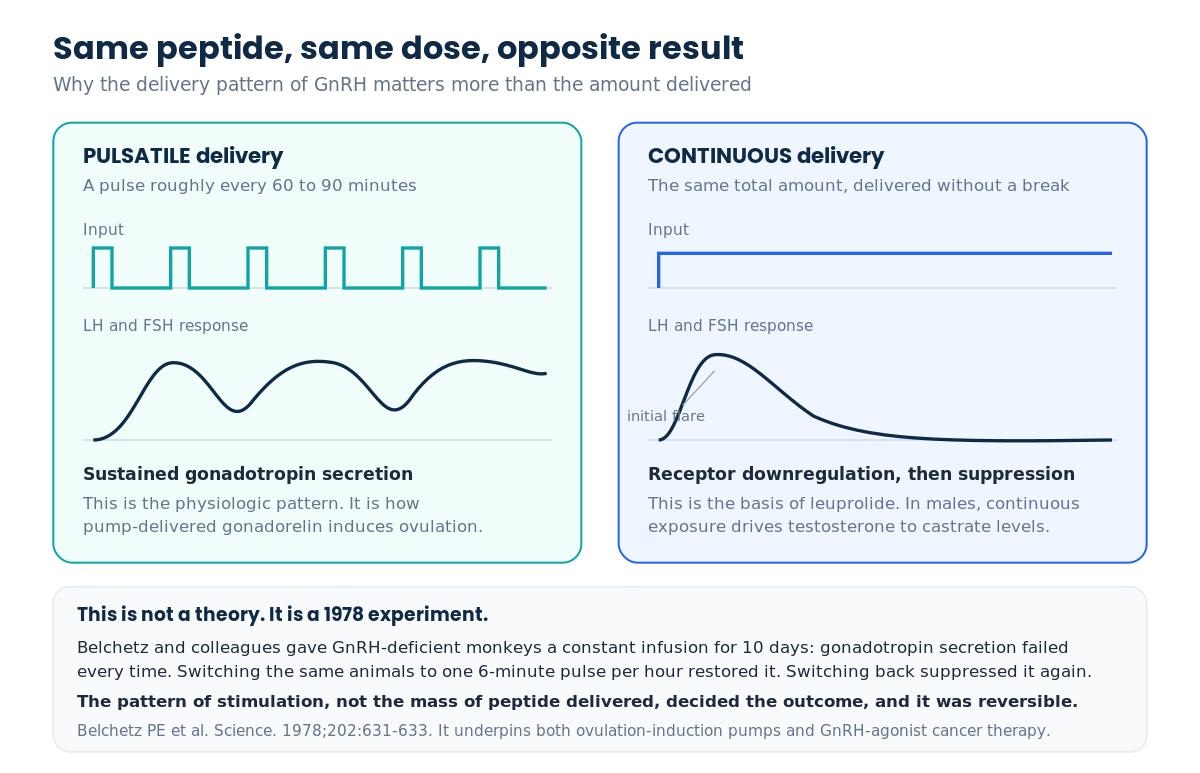
In 1978, Belchetz and colleagues gave GnRH-deficient monkeys continuous GnRH infusions at four different doses for ten days. Gonadotropin secretion failed every time. The same animals, switched to a single six-minute pulse once an hour, recovered normal secretion — and switching back to continuous suppressed them again. As one of the authors later put it, the pattern of stimulation rather than the total mass of peptide delivered was what mattered.
This is not an obscure result. It is why Lutrepulse was delivered by pump at 5 micrograms every 90 minutes, and it is why Lutrepulse’s own overdose section warns that “continuous, non-pulsatile exposure to gonadorelin acetate could temporarily reduce pituitary responsiveness.”
Follow that logic to its endpoint and you arrive at leuprolide — a GnRH agonist used to shut the axis down. Its FDA label describes an initial rise in LH, FSH and gonadal steroids, then the real effect: “continuous administration of leuprolide acetate results in decreased levels of LH and FSH. In males, testosterone is reduced to castrate levels,” typically within two to four weeks.
Gonadorelin side effects: what the label actually documents
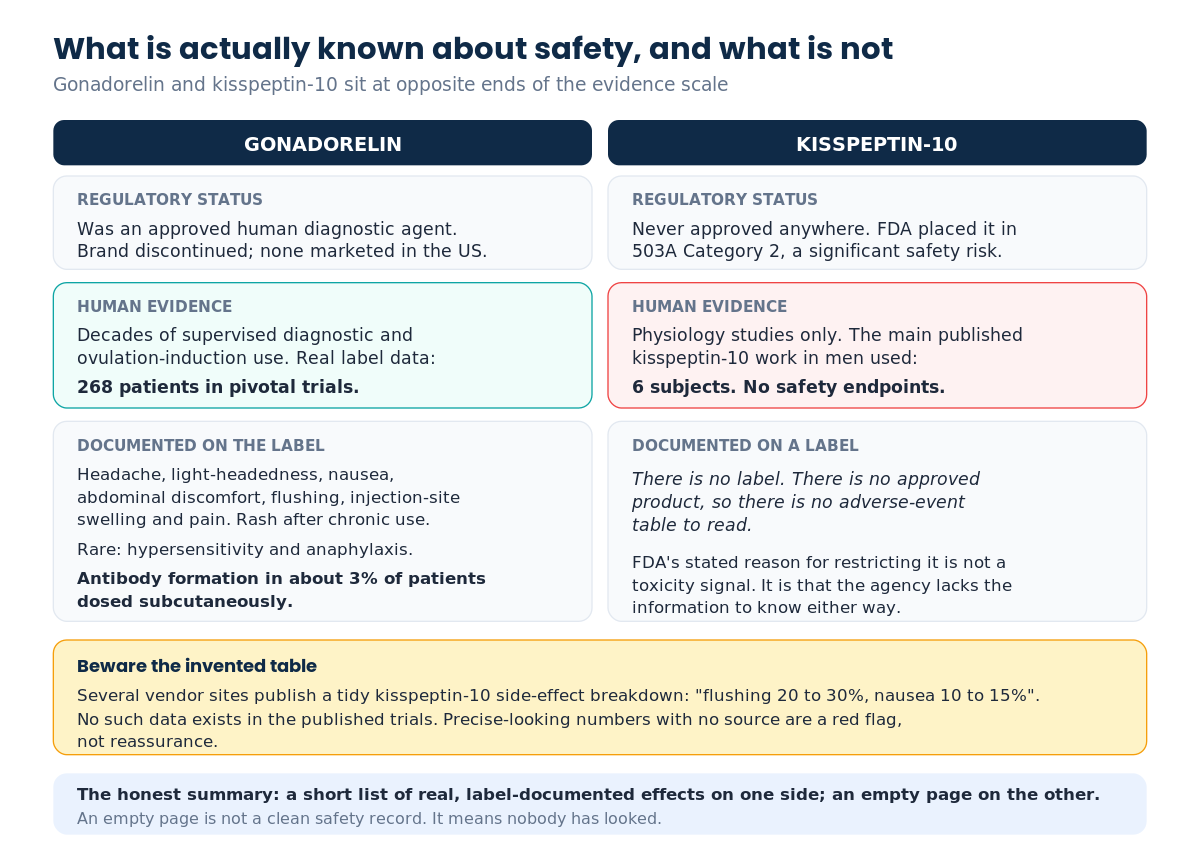
From the human Factrel prescribing information, which states that systemic effects were reported rarely following a 100 microgram dose:
- Central nervous system — headache, light-headedness
- Gastrointestinal — nausea, abdominal discomfort
- Dermatologic — local swelling, sometimes with pain and itching, at the subcutaneous injection site; local and generalized skin rash after chronic subcutaneous administration
- Cardiovascular — flushing
- Hypersensitivity — rare instances of bronchospasm, tachycardia, flushing, urticaria and induration, and anaphylactic reactions, reported after multiple-dose administration
- Antibody formation — reported rarely after chronic administration of large doses
- Reproductive — repetitive, high doses may cause luteolysis and inhibition of spermatogenesis
Note what is absent: the human Factrel label attaches no incidence percentages to any of these. It says “rarely.” Anyone quoting you a percentage from this label is quoting something that is not there.
Real numbers do exist, from the Lutrepulse product monograph:
- Adverse reactions in approximately 10% of treatment regimens in pivotal trials; 10 of 268 patients interrupted therapy, and all but one resumed
- Antibody formation in approximately 3% of patients treated subcutaneously — in some cases associated with reduced effectiveness. This is the only solid immunogenicity figure in this space, and it pairs directly with the FDA’s stated concerns about peptide immunogenicity
- Ovarian hyperstimulation in under 1%; one case of moderate OHSS among 268 women, with concomitant clomiphene
- Most effects were route-related: superficial thrombophlebitis and injection-site irritation
Contraindications are worth reading as a warning about unsupervised use: hypersensitivity, ovarian cysts, hormone-dependent tumours, and any condition exacerbated by pregnancy. The Factrel label also records a case of pituitary apoplexy and sudden blindness after GnRH administration in a patient with a gonadotropin-secreting adenoma — and leuprolide’s postmarketing data corroborates the pattern, with most apoplexy cases occurring in patients with an undiagnosed pituitary adenoma, some within the first hour of the first dose. The point is not that this is common. It is that “undiagnosed” is doing the work in that sentence.
Kisspeptin-10: what the human evidence actually consists of
Here it is in full. The principal published kisspeptin-10 study in men (George et al., JCEM 2011, from Edinburgh) used intravenous boluses in six subjects, with four more in the infusion arm. It is a physiology study. It has no safety endpoints, and its abstract reports no adverse events because it was not designed to find any.
One finding from it deserves attention, though: 3 micrograms/kg produced a smaller LH response than 1 microgram/kg. Desensitization, visible inside a single dose-response curve. The paper is indexed under “Tachyphylaxis.” A second study (Jayasena et al., JCEM 2011, n=4-5 per group) found kisspeptin-10 stimulated gonadotropin release in men and in women during the preovulatory phase, but failed to do so in women during the follicular phase.
The FDA’s reasoning for Category 2 is instructive precisely because it is not a toxicity finding. In its own words, compounded kisspeptin-10 “may pose risk for immunogenicity for certain routes of administration and may have complexities with regard to peptide-related impurities and API characterization. FDA has no, or only limited, safety-related information for the proposed routes of administration. Therefore, the agency lacks sufficient information to know whether the drug would cause harm when administered to humans.”
That is a statement about ignorance, not danger. It is also the more honest message: nobody knows.
The side-effect table that does not exist
Several vendor pages publish a clean-looking kisspeptin-10 breakdown — flushing in 20-30%, mild nausea in 10-15%, injection-site reactions in 5-10%. We went looking for the source. There isn’t one. Those figures appear only on commercial peptide sites; they are in none of the published trials, which report tolerability narratively and in single-digit subject counts.
This is worth internalising as a general skill: precise-looking numbers with no citation are a red flag, not reassurance. A real percentage comes attached to a denominator and a study. An invented one is offered without either, and reads as more authoritative for exactly that reason.
Product quality: the concrete risk
With research-grade material the most defensible concern is not an exotic toxicity — it is what is in the vial. The FDA’s Category 2 rationales repeatedly identify the same class problems for compounded peptides: immunogenicity risk from aggregation and peptide-related impurities, difficulty characterizing the active ingredient, and absent human safety data. It states this for kisspeptin-10 specifically, and near-identically for GHRP-2, GHRP-6, ipamorelin, BPC-157, CJC-1295, TB-500 and others.
Gonadorelin’s ~3% antibody-formation rate via the subcutaneous route is a useful anchor here: that was a pharmaceutical-grade product under supervision. Immunogenicity is not hypothetical for this class. Reading a Certificate of Analysis properly, and understanding what endotoxin testing does and does not tell you, is the practical response.
Sport status
Both are prohibited. The 2026 WADA Prohibited List, S2.2.1 (“Testosterone-stimulating peptides in males”) names “gonadotrophin-releasing hormone (GnRH, gonadorelin) and its agonist analogues” and “kisspeptin and its agonist analogues” explicitly. S2 substances are non-Specified and prohibited at all times. See our guide to why peptides are banned in sport.
Frequently asked questions
Is gonadorelin safer than kisspeptin-10 because it has a label?
It is better characterised, which is not the same thing. We know what gonadorelin does at supervised diagnostic and pump-delivered doses because that was studied. That knowledge does not automatically transfer to unsupervised use on a different schedule — and, as the pulsatility research shows, schedule can invert the effect entirely.
Why does the same peptide stimulate in one setting and suppress in another?
Because the receptor adapts to continuous stimulation. Pulsatile GnRH sustains gonadotropin release; continuous exposure downregulates the pituitary response. It is the same molecule at the same receptor — the difference is entirely in the timing.
Kisspeptin trials reported no adverse events. Doesn’t that mean it’s safe?
No. “No adverse events reported” in a six-person physiology study with no safety endpoints means the study was not looking. Small, short, single-dose studies in healthy young volunteers cannot detect uncommon harms, and nothing in that literature speaks to repeated self-administration over months.
Was gonadorelin withdrawn because it was dangerous?
The sources do not support that. The brands were discontinued and withdrawn from marketing; the Lutrepulse US withdrawal has been described as commercial. There is no safety-withdrawal evidence, and it is worth not repeating the claim.
References
- Belchetz PE, Plant TM, Nakai Y, Keogh EJ, Knobil E. Hypophysial responses to continuous and intermittent delivery of hypothalamic gonadotropin-releasing hormone. Science. 1978;202:631-633. PMID 100883
- George JT, Veldhuis JD, Roseweir AK, et al. Kisspeptin-10 is a potent stimulator of LH and increases pulse frequency in men. J Clin Endocrinol Metab. 2011;96(8):E1228-36. PMID 21632807
- FDA. Certain Bulk Drug Substances for Use in Compounding That May Present Significant Safety Risks (503A Category 2; kisspeptin-10 added 29 Sept 2023). fda.gov
- PrLUTREPULSE (gonadorelin acetate for injection) Product Monograph, Ferring Inc. pdf.hres.ca (PDF)
- LUPRON DEPOT 7.5 mg (leuprolide acetate) FDA label. accessdata.fda.gov (PDF)
- Abbara A, et al. Efficacy of kisspeptin-54 to trigger oocyte maturation in women at high risk of OHSS during IVF therapy. J Clin Endocrinol Metab. 2015;100(9):3322. academic.oup.com
- WADA. The 2026 Prohibited List (S2.2.1 names gonadorelin and kisspeptin). wada-ama.org
- PubChem. Gonadorelin, CID 638793. pubchem.ncbi.nlm.nih.gov
Informational only — not medical advice · 21+. VialHelp does not sell or recommend peptides and does not provide dosing protocols. Every dose figure cited on this page comes from a supervised clinical or diagnostic protocol. Consult a qualified healthcare professional for any medical decision.