
Constitutive Activity: Why the Ghrelin Receptor Is Always “On”
A receptor is usually drawn like a light switch: a signaling molecule (the ligand) flips it on, and with nothing bound it sits quietly at zero. Constitutive activity is the finding that breaks that picture — many receptors generate a signal on their own, with no ligand attached at all. The ghrelin receptor is the textbook case: in the lab it fires at roughly half of its maximum even when no ghrelin is anywhere near it.
What “constitutive activity” actually means
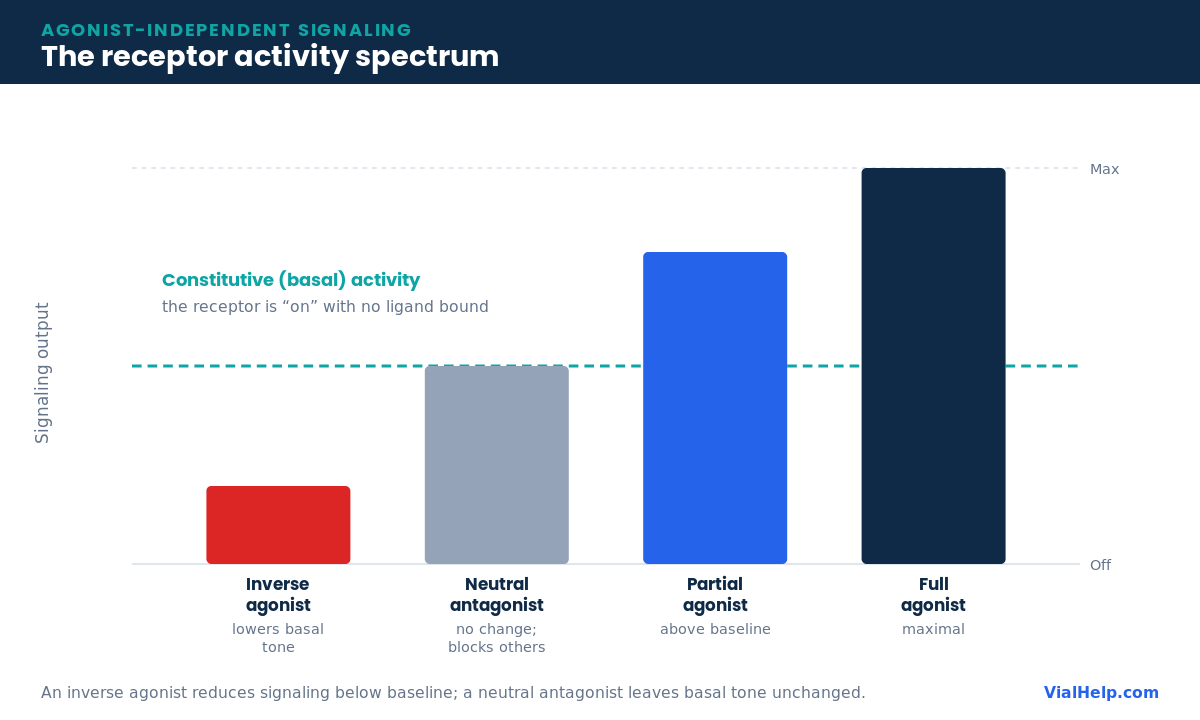
Constitutive activity (also called basal activity) is agonist-independent signaling: some of the time the receptor spontaneously adopts its active shape and drives downstream signaling without being switched on by anything. It is a low, standing hum of output that exists before any drug or hormone arrives.
That reframes what a drug does. An agonist doesn’t create a signal out of nothing — it raises output above the basal set-point. The effect you measure is a change from the baseline, not the whole signal. And a receptor with meaningful basal tone opens the door to a kind of drug that only makes sense once you accept constitutive activity: one that turns the standing signal down.
Agonist, antagonist, inverse agonist — all measured against the baseline
Once there is a baseline, three different things a ligand can do come into focus:
- Agonist (full or partial): stabilizes the active state and pushes output above the basal level — a full agonist to the maximum, a partial agonist only part-way.
- Neutral antagonist: occupies the receptor and blocks other ligands, but leaves the basal tone unchanged. It is a doorstop, not a dimmer.
- Inverse agonist: stabilizes the inactive state and lowers activity below baseline — so-called negative efficacy.
The ghrelin receptor: about half-on with no ligand
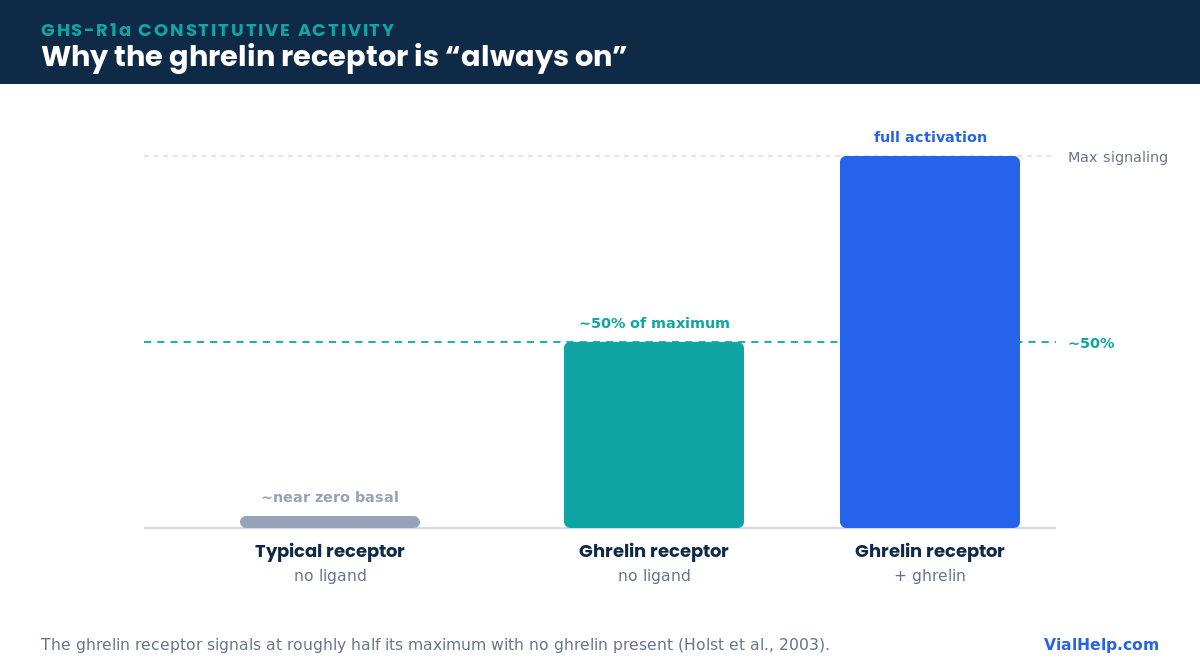
The growth hormone secretagogue receptor, GHS-R1a — the receptor ghrelin acts on — is one of the most constitutively active G-protein-coupled receptors known. In a 2003 study, Birgitte Holst and colleagues showed it signals at roughly 50% of its maximal capacity in the complete absence of ghrelin, acting through the Gq/11–phospholipase C pathway that raises intracellular calcium. A modified substance-P analog behaved as a full inverse agonist, dialing that basal signal back toward zero.
One honest caveat: the “~50%” figure is an in-vitro estimate in cells engineered to overexpress the receptor, so read it as “roughly half,” not an exact physiological constant. The qualitative point — that this receptor does a lot with nothing bound — is well established.
How we know the basal tone actually matters
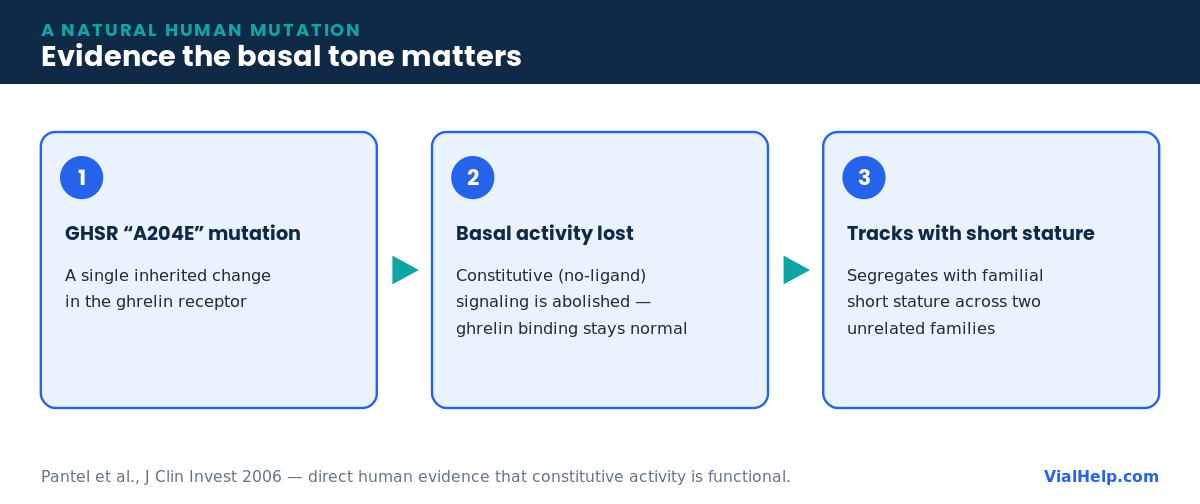
Cell-culture numbers are one thing; a human phenotype is another. In 2006, Pantel and colleagues found a naturally occurring mutation in the ghrelin receptor, A204E, in two unrelated families affected by short stature. Remarkably, the mutation selectively abolishes the receptor’s constitutive activity while leaving its ability to bind ghrelin intact — and it segregated with short stature across the families.
The fair caveat is that the same mutation also reduces how much receptor reaches the cell surface, so the phenotype can’t be pinned on lost basal tone alone. Even so, it is direct human evidence that agonist-independent signaling isn’t a lab curiosity — it appears to be doing real physiological work in setting the growth and appetite “set-point.”
Other receptors that hum without a ligand
The ghrelin receptor is the dramatic example, but constitutive activity is a normal feature of receptor biology, not a fringe case:
- The melanocortin-4 receptor (MC4R): it has well-documented basal activity, and the body’s own peptide AgRP acts as an inverse agonist, opposing α-MSH — a tug-of-war that helps set appetite and body weight.
- The CB1 cannabinoid receptor: it signals constitutively through Gi/o proteins; the drug rimonabant behaves as an inverse agonist, shifting the receptor toward its inactive state.
Why this matters when you read “binds receptor X”
In the research-peptide world, compounds are usually described in one word: a peptide “activates” or “blocks” some receptor. Constitutive activity shows why that binary is too crude. At a receptor with standing tone, a molecule can push output up (agonist), silence the baseline hum (inverse agonist), or simply shield the receptor from other ligands without changing the tone (neutral antagonist). Those are three genuinely different pharmacologies that a single verb flattens into one. Knowing that a receptor can be doing something with nothing bound is part of reading any “binds receptor X” claim critically.
Frequently asked questions
Does constitutive activity mean the receptor is broken or overactive?
No. It is a normal property of many receptors. The receptor spends a fraction of its time in the active shape by chance; that produces a low, steady signal that is part of the system’s baseline, not a malfunction.
If the ghrelin receptor is already half-on, does ghrelin still do anything?
Yes. Ghrelin binding pushes the receptor from its ~50% basal level toward full activation, adding signal on top of the standing tone. The baseline and the ligand-driven response are two separate contributions.
What’s the difference between an antagonist and an inverse agonist?
A neutral antagonist blocks other ligands but leaves basal activity untouched. An inverse agonist actively reduces the basal signal below its resting level. They look similar in a simple “does it block the agonist?” test but do opposite things to a receptor’s standing tone.
Do all receptors have constitutive activity?
No — it varies enormously. Some receptors have almost none and behave much more like a simple on/off switch; others, like GHS-R1a, have a great deal. The amount is a measurable property of each receptor.
- Holst B, et al. High constitutive signaling of the ghrelin receptor — identification of a potent inverse agonist. Mol Endocrinol. 2003;17(11):2201–2210. https://academic.oup.com/mend/article/17/11/2201/2747365
- Pantel J, et al. Loss of constitutive activity of the growth hormone secretagogue receptor in familial short stature. J Clin Invest. 2006;116(3):760–768. https://www.jci.org/articles/view/25303
- Els S, et al. Ghrelin receptor constitutive activity and its physiological relevance (review). Front Neurosci. https://pmc.ncbi.nlm.nih.gov/articles/PMC3665924/
- Khilnani G, Khilnani AK. Inverse agonism and its therapeutic significance. Indian J Pharmacol. 2011. https://pmc.ncbi.nlm.nih.gov/articles/PMC3195115/
- Constitutive activity of neural melanocortin receptors (MC4R / AgRP). Methods Enzymol. https://pubmed.ncbi.nlm.nih.gov/21036237/
- Constitutive activity of the cannabinoid CB1 receptor and rimonabant. https://pmc.ncbi.nlm.nih.gov/articles/PMC2931562/
Informational only — not medical advice. VialHelp is an educational resource and does not sell or recommend peptides. Nothing here is a dosing or treatment recommendation. 21+.