
What Is Endothelin? The Most Powerful Vasoconstrictor the Body Makes
Peptide science
In 1988 a team at the University of Tsukuba reported in Nature that cultured pig aortic endothelial cells release a small peptide that clamps blood vessels shut harder, and for far longer, than anything then known. They called it endothelin, after the endothelium — the single-cell lining that produces it. Nearly four decades later endothelin is the target of six approved medicines, and it is still the standard example of how a 21-amino-acid molecule can outmuscle much larger signals.
What is endothelin?
Endothelin is a family of three closely related peptides — endothelin-1, endothelin-2 and endothelin-3 — each 21 amino acids long and each encoded by its own gene (EDN1, EDN2, EDN3). Endothelin-1 is the one that matters most in human blood vessels. Its gene sits on chromosome 6, and the protein carries the UniProt accession P05305.
The family is small but strange. Endothelin-2 differs from endothelin-1 by just two amino acids. Endothelin-3 differs by six, and that is enough to change its behaviour: it is the only one of the three that clearly tells the two endothelin receptors apart at ordinary concentrations. It is also the most abundant endothelin in the rodent brain, which earned it the informal name “brain endothelin”.
There is a memorable footnote. The sarafotoxins, found in the venom of the burrowing asp Atractaspis engaddensis, are close sequence relatives of the endothelins, and envenomation constricts the coronary arteries hard enough to stop the heart. Evolution appears to have found the same molecular trick twice — once as a signal, once as a weapon. If the vocabulary here is new, our primer on what a peptide actually is covers the basics.
Three cuts: how endothelin-1 is made
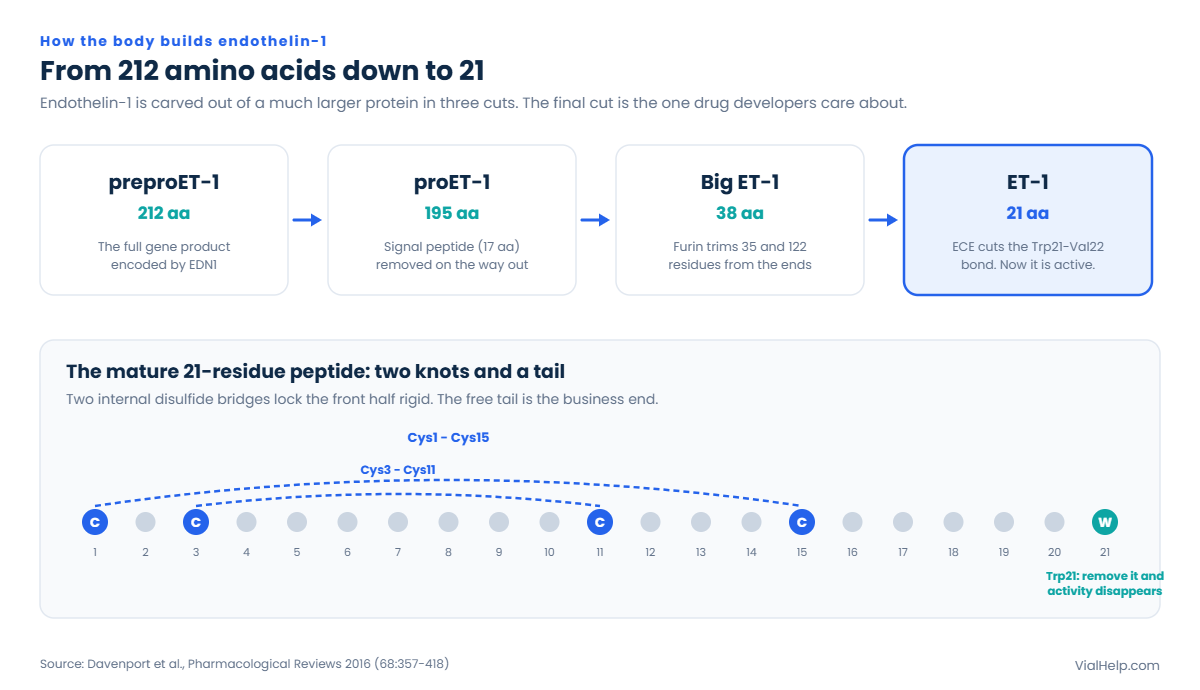
Endothelin-1 does not come off the ribosome ready to use. The EDN1 gene encodes a 212-amino-acid precursor called preproendothelin-1. A signal peptidase strips a 17-residue signal sequence. Furin enzymes then trim 35 residues from one end and 122 from the other, leaving a 38-residue intermediate known as Big ET-1. The final step is the one that matters pharmacologically: endothelin-converting enzyme cuts the bond between tryptophan-21 and valine-22, and the mature 21-residue peptide is released.
The finished molecule has an unusual architecture. Two internal disulfide bridges — cysteine 1 to cysteine 15, and cysteine 3 to cysteine 11 — lock the front two thirds into a rigid double-looped core, leaving a free tail. That tail is the business end. Remove the terminal tryptophan and activity disappears entirely; several neighbouring residues are also critical for receptor binding.
This staged assembly line is the same general strategy the body uses for insulin and most other peptide hormones, which we cover in prohormone processing.
Two receptors, opposite jobs
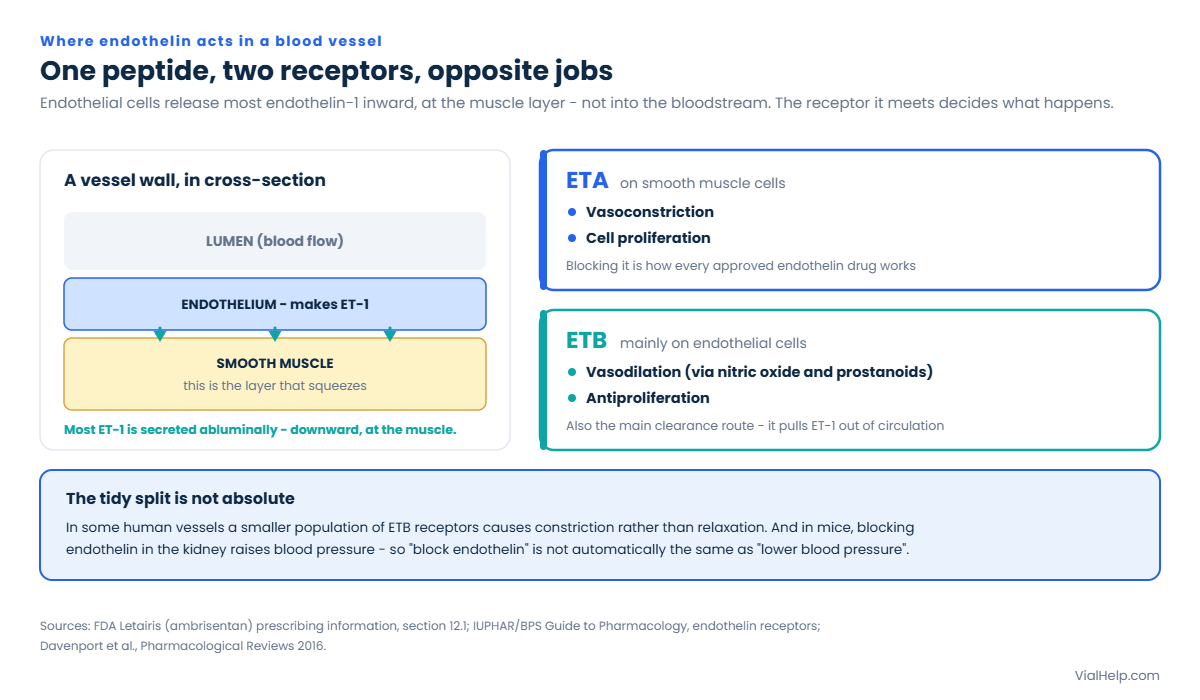
Endothelin works through two G-protein-coupled receptors: ETA (gene EDNRA) and ETB (EDNRB). Both are seven-transmembrane, rhodopsin-family receptors, and both are unusual in having long extracellular tails.
An FDA-approved label states the division of labour concisely: the primary actions of ETA are vasoconstriction and cell proliferation, while the predominant actions of ETB are vasodilation, antiproliferation and clearance of endothelin-1.
Location explains most of that. ETA receptors sit mainly on the smooth muscle cells that form the vessel’s contractile layer. ETB receptors sit mainly on the endothelial cells lining the lumen, where switching them on releases nitric oxide and prostanoids — relaxing signals. ETB is also the main disposal route: once endothelin-1 binds ETB, the pair is pulled into the cell and destroyed in the lysosome. Bound to ETA, by contrast, the receptor recycles back to the surface. That difference has a practical consequence — an ETA blocker can reverse a constriction already under way, whereas an ETB blocker cannot dislodge ligand that is already bound.
One more detail changes how you should read blood tests. Endothelial cells release most endothelin-1 abluminally, inward at the muscle, rather than into the bloodstream. Plasma endothelin is therefore a poor proxy for what the peptide is doing in the vessel wall.
The tidy split is not absolute either. In several animal vessels ETB causes constriction rather than relaxation, and a smaller constricting population of ETB receptors exists in some human vessels too.
The counterweight to the body’s relaxing signals
Blood pressure is not set by any single system. Endothelin is the constricting side of a ledger whose other side includes nitric oxide, prostacyclin and the natriuretic peptides. The renin-angiotensin-aldosterone system runs alongside it, the kallikrein-kinin system pushes the other way, and neprilysin degrades several of the players on both sides.
What sets endothelin apart is duration. A major pharmacology review calls it the most potent vasoconstrictor in the human cardiovascular system, with remarkably long-lasting action: in anaesthetised, denervated rats a single dose raised arterial pressure for more than an hour, and contractions in isolated vessels are notoriously hard to wash out. That distinction between how long a peptide lasts in plasma and how long its effect lasts is worth understanding — see peptide half-life explained.
Endothelin also drives cell growth, though in a specific way: it is described as co-mitogenic, amplifying the effect of other growth factors such as PDGF rather than acting as a growth signal on its own. And as an evolutionary curiosity, endothelin genes are found only in vertebrates.
Blocking endothelin: the drug arc

Every approved endothelin drug blocks a receptor rather than the peptide, and none of them is itself a peptide — they are all small molecules taken by mouth.
- Bosentan (2001) — the first, a dual ETA/ETB antagonist for pulmonary arterial hypertension.
- Ambrisentan (2007) — strongly ETA-selective, with more than 4,000-fold selectivity over ETB according to its label.
- Macitentan (2013) — also for pulmonary arterial hypertension.
- Sparsentan (2023) — endothelin blockade aimed at a kidney disease, IgA nephropathy, rather than the lungs.
- Aprocitentan (2024) — for high blood pressure not adequately controlled by other drugs.
- Sitaxentan — authorised in the European Union in 2006 and withdrawn worldwide in December 2010 after two fatal cases of liver injury. It did not reach the US market.
What the labels flag
Four issues recur across the class, and they are worth knowing because they show what happens when you switch off a signal the body uses continuously.
- Embryo-fetal toxicity. These drugs are contraindicated in pregnancy. Several require or have required restricted-access programmes with monthly pregnancy testing.
- Fluid retention and oedema. The ambrisentan label calls peripheral oedema “a known class effect of endothelin receptor antagonists”.
- Falling haemoglobin. In 12-week trials the mean drop on ambrisentan was 0.8 g/dL, with a marked decrease in 7% of treated patients versus 4% on placebo, and postmarketing reports of anaemia requiring transfusion.
- Liver injury — but not uniformly. Bosentan and sparsentan carry boxed hepatotoxicity warnings. Ambrisentan’s was removed in 2011 after FDA reviewed more than 7,800 patient-years of data; in its 12-week controlled trials, aminotransferase elevations above three times the upper limit of normal occurred in 0% of treated patients and 2.3% on placebo.
Decreased sperm counts are also noted across the class. None of this is a reason to avoid a prescribed medicine; it is a reason those medicines are monitored the way they are.
Frequently asked questions
What does endothelin actually do?
Its best-characterised job is narrowing blood vessels by acting on ETA receptors in the muscle layer of the vessel wall, and it does so unusually powerfully and unusually durably. It also contributes to cell proliferation, kidney sodium handling and, through ETB receptors on the endothelium, to vasodilation and its own clearance.
Is endothelin the same thing as endothelin-1?
Not quite. Endothelin is the family name for three peptides. Endothelin-1 is the member made by blood vessel endothelium and the one almost every clinical discussion is about. When a paper says “endothelin” without qualification, it usually means endothelin-1.
Why do endothelin-blocking drugs cause swelling?
Peripheral oedema is explicitly described on FDA labelling as a class effect of endothelin receptor antagonists. It also overlaps with the swelling caused by the conditions these drugs treat, which is part of why labels tell prescribers to investigate the cause rather than assume it is the drug.
Can endothelin be measured in a blood test?
Endothelin-1 and unconverted Big ET-1 are detectable in plasma, and levels are markedly raised in pulmonary arterial hypertension — the ambrisentan label cites concentrations up to ten times higher. But because most endothelin is secreted inward rather than into the blood, a plasma value understates local activity. It is a research measurement, not a routine clinical test.
References
- Yanagisawa M, et al. A novel potent vasoconstrictor peptide produced by vascular endothelial cells. Nature 1988;332:411-415. nature.com
- Davenport AP, Hyndman KA, Dhaun N, et al. Endothelin. Pharmacological Reviews 2016;68(2):357-418. PMC4815360
- Endothelin receptors: Introduction. IUPHAR/BPS Guide to Pharmacology. guidetopharmacology.org
- LETAIRIS (ambrisentan) US prescribing information. accessdata.fda.gov
- TRACLEER (bosentan) US prescribing information. accessdata.fda.gov
- Thelin (sitaxentan) to be withdrawn due to cases of unpredictable serious liver injury. European Medicines Agency, 10 December 2010. ema.europa.eu
- EDN1 endothelin 1 [Homo sapiens]. NCBI Gene. ncbi.nlm.nih.gov
Informational only — not medical advice · 21+. Consult a qualified healthcare professional about any medicine or medical condition.