
The Pituitary Gland: The Master Gland Explained
Hormone biology
The pituitary gland is a small structure at the base of the brain with an outsized job: it is the relay station that turns signals from the brain into commands for glands all over the body. It has earned the nickname “the master gland,” but as this guide shows, it is really two very different organs fused into one — and it sits at the center of nearly every hormone axis on this site.
What the pituitary gland is
The pituitary gland (hypophysis) sits in a small bony pocket called the sella turcica, just beneath the hypothalamus, to which it is directly connected. It has two anatomically and functionally distinct lobes: the anterior lobe (adenohypophysis), made of glandular tissue, and the posterior lobe (neurohypophysis), which is actually nervous tissue — an extension of the hypothalamus itself. (A small intermediate lobe exists but is essentially vestigial in adults.)
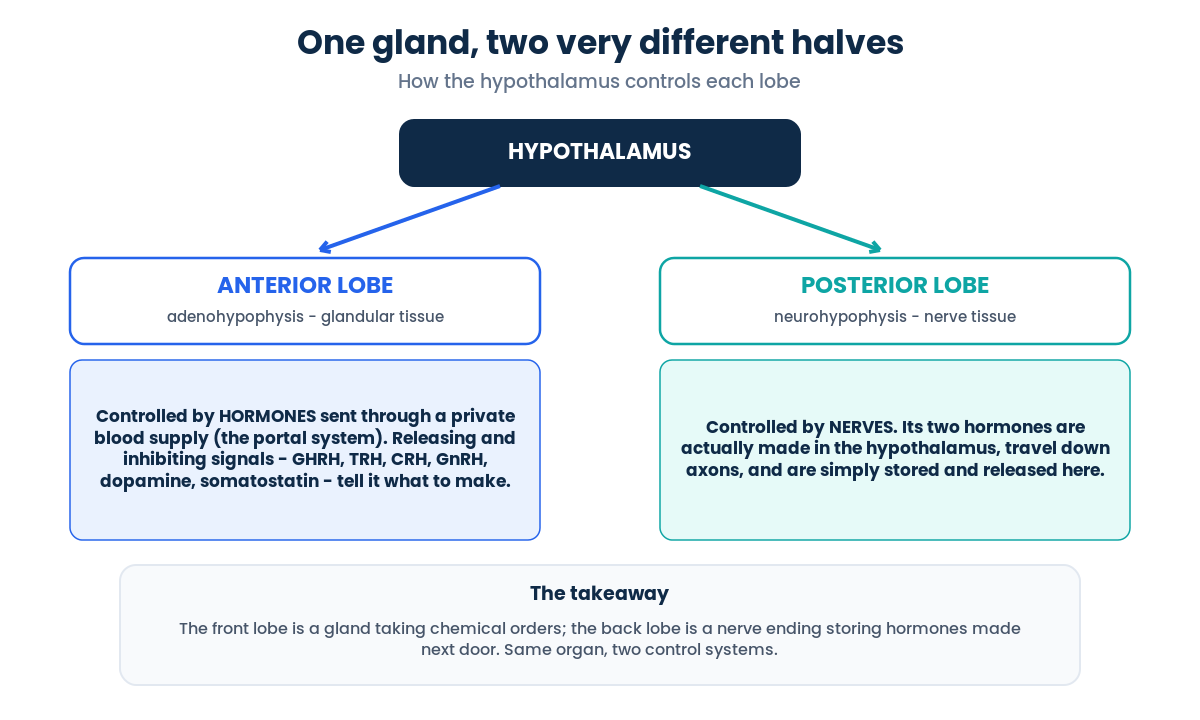
Two lobes, two control systems
The two lobes are run in completely different ways. The anterior lobe takes chemical orders: the hypothalamus secretes releasing and inhibiting hormones — GHRH, TRH, CRH, GnRH, dopamine and somatostatin — into a private set of blood vessels called the hypophyseal portal system, which delivers them straight to the anterior pituitary cells. The posterior lobe is run by nerves: its two hormones are not made there at all. They are produced by hypothalamic neurons, travel down their axons, and are simply stored in the posterior lobe until a nerve signal triggers their release.
The six anterior pituitary hormones
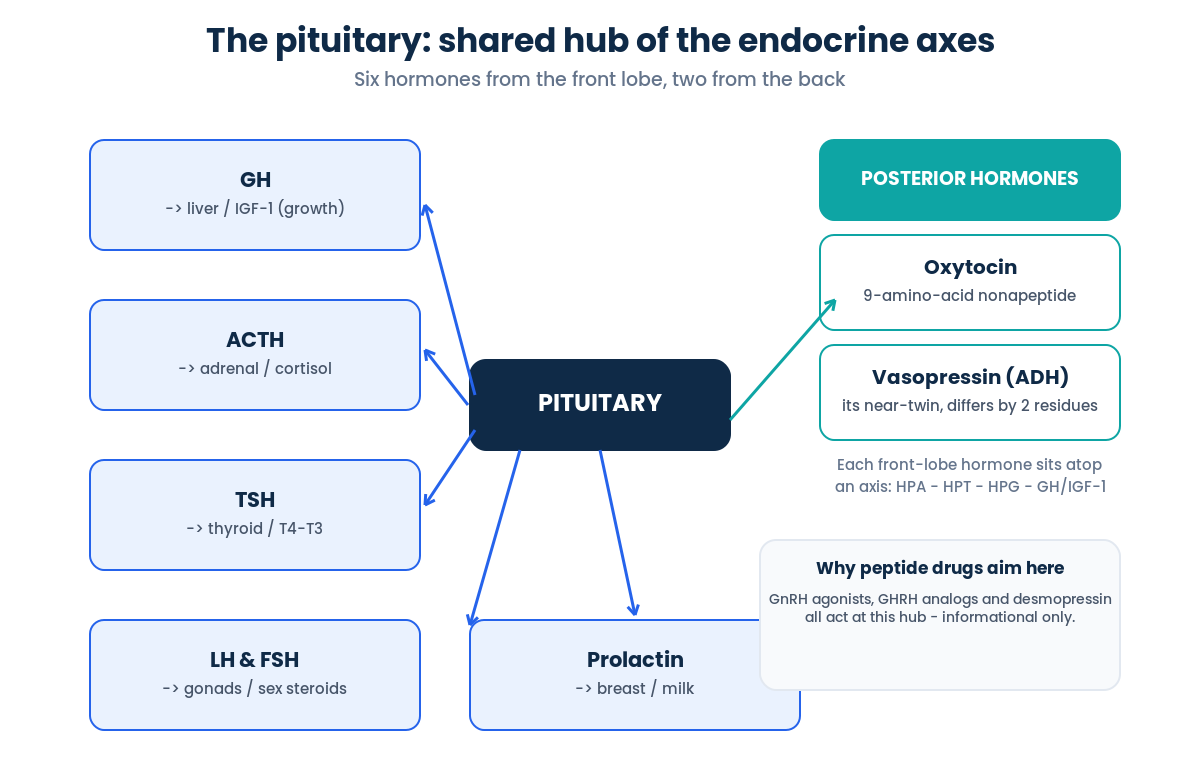
The anterior lobe makes six classic hormones, each aimed at a different target:
- Growth hormone (GH) — drives body growth, largely through IGF-1 from the liver.
- ACTH — tells the adrenal cortex to make cortisol.
- TSH — tells the thyroid to make thyroid hormone.
- LH and FSH — the gonadotropins, which act on the ovaries and testes.
- Prolactin — drives milk production and is unusual in being held in check by dopamine rather than switched on.
The two posterior pituitary hormones
The posterior lobe stores and releases just two hormones: oxytocin and vasopressin (ADH). Both are nonapeptides — nine amino acids long — and they are near-twins, differing by only two residues, yet they do very different jobs (uterine contraction and milk ejection for oxytocin; water balance and blood-vessel tone for vasopressin).
Different hormones, different machinery
One of the most useful things to know about the pituitary gland is that its hormones are not built alike. They fall into three molecular families that use two different receptor styles:
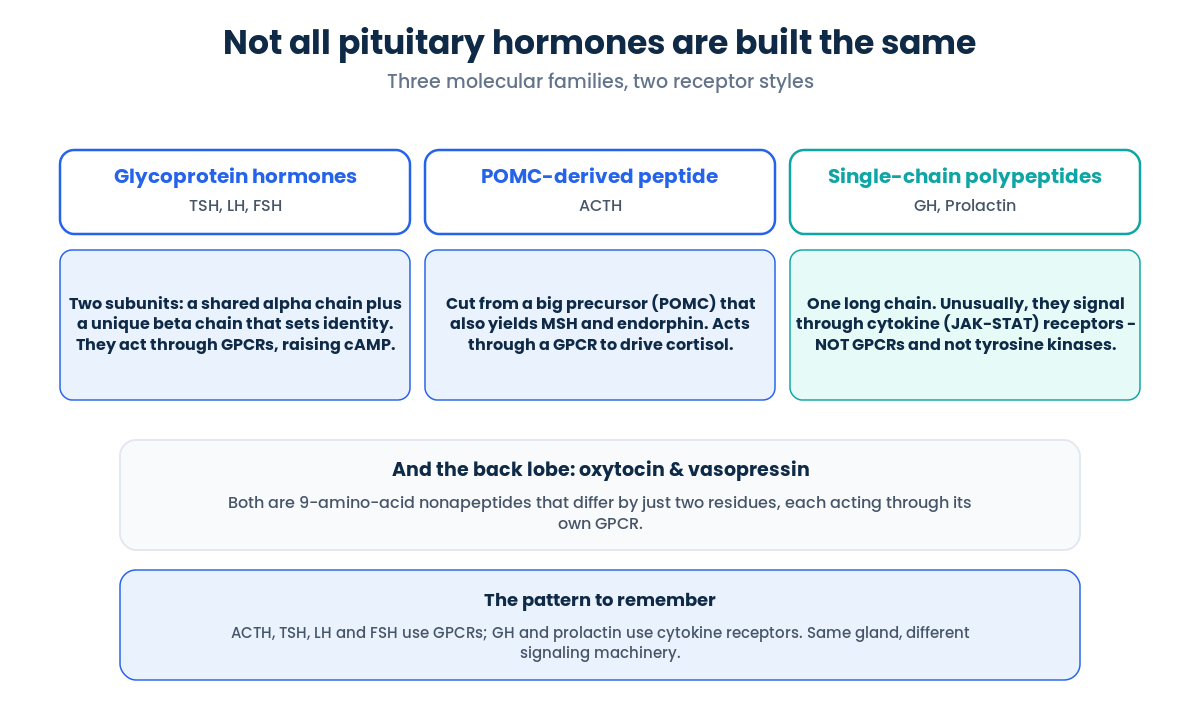
TSH, LH and FSH are glycoprotein hormones that share a common alpha subunit and act through GPCRs; ACTH is a peptide cut from the larger POMC precursor and also uses a GPCR; and GH and prolactin are single-chain polypeptides that signal through cytokine (JAK-STAT) receptors — not GPCRs and not the tyrosine kinases used by insulin. Same gland, three different toolkits.
The hub of the endocrine axes
The reason the pituitary gland matters so much is that each anterior hormone sits at the top of its own axis: ACTH heads the HPA (cortisol) axis, TSH the HPT (thyroid) axis, LH and FSH the HPG (reproductive) axis, and GH the GH and IGF-1 axis. Every one of these loops is governed by negative feedback — cortisol, thyroid hormone, sex steroids and IGF-1 all report back to suppress their own signals.
Because these axes are the body’s hormonal control points, a great many peptide medicines are designed to act right here — GnRH agonists and antagonists at the gonadotroph, GHRH analogs such as sermorelin, tesamorelin and CJC-1295 at the GH axis, and desmopressin as a vasopressin stand-in. Understanding the pituitary makes the logic behind those compounds much clearer.
Frequently asked questions
Why is the pituitary called the “master gland”?
Because its hormones control other glands — the thyroid, adrenals and gonads all take their orders from pituitary signals. In truth the hypothalamus sits above it, so the pituitary is more of a master relay than a sole commander.
What is the difference between the anterior and posterior pituitary?
The anterior lobe is glandular tissue that makes its own hormones on chemical instructions delivered by blood. The posterior lobe is nervous tissue that only stores and releases two hormones made in the hypothalamus.
Are all pituitary hormones peptides?
They are all peptides or proteins, but of different kinds: glycoprotein hormones (TSH, LH, FSH), a POMC-derived peptide (ACTH), single-chain polypeptides (GH, prolactin), and two short nonapeptides (oxytocin, vasopressin).
Why do so many peptide drugs target the pituitary axes?
Because these axes are natural control points for growth, stress, metabolism and reproduction, mimicking or blocking a pituitary-level signal is a powerful lever — which is why so many hormone drugs are built around them.
Related reading
Reconstitution calculator · Peptide library · Guides & how-tos
References
- StatPearls. Physiology, Pituitary Gland (NBK459247). ncbi.nlm.nih.gov/books/NBK459247
- StatPearls. Physiology, Anterior Pituitary (NBK499898). ncbi.nlm.nih.gov/books/NBK499898
- StatPearls. Physiology, Posterior Pituitary (NBK526130). ncbi.nlm.nih.gov/books/NBK526130
- Endotext. Functional Anatomy of the Hypothalamus and Pituitary (NBK279126). ncbi.nlm.nih.gov/books/NBK279126
- UniProt. Oxytocin-neurophysin 1 (OXT), P01178; Vasopressin-neurophysin 2 (AVP), P01185. uniprot.org/uniprotkb/P01178
- Le Tissier et al. Cellular and Molecular Specificity of Pituitary Gland Physiology. Physiological Reviews. journals.physiology.org
Informational only — not medical advice. Consult a qualified healthcare professional. Intended for adults 21+.